Showing posts with label medieval. Show all posts

Thursday, December 11, 2025

BOOK REVIEW: Inês by Catherine Mathis

I’m excited to follow up my recent medieval historical read, Canticle by Janet Rich Edwards, with Inês by Catherine Mathis. This novel swept me away to a time and place I haven’t visited in fiction before, 14th century Portugal, introducing me to fascinating new-to-me historical events.

The novel is based on the legend of Inês, the crowned queen of Portugal, second wife of King Pedro. What makes her story unique is that she was crowned six years after her death.

Pedro is the only surviving son of King Afonso, and he dutifully marries the royal Lady Constanza as per his father’s wish. However, he is infatuated with Constanza’s lady-in-waiting and close friend, Inês. Inês does have royal blood, but since she is illegitimate, she’s considered unsuitable to be Pedro’s wife. Her devotion to Constanza means she will not be Pedro’s mistress. Inês’ beauty also attracts the notice of King Afonso’s most trusted advisor, Gonçalves. When she rebuffs his attentions, Gonçalves is insulted and swears vengeance.

Pedro is physically faithful to Constanza, but falls deeper and deeper in love with Inês, a love that is returned. After Constanza’s death, Pedro and Inês are married, quickly and secretly, against the wishes of Pedro’s father, the king. Afonso refuses to believe in the legitimacy of the marriage, setting the stage for the violence to come.

The novel brings these characters vividly to life, wrapping the love story in the politics, upheavals, wars, and plagues of the period. Readers will sympathize with the star-crossed lovers, (known as Portugal’s Rome and Juliet) and will find grim satisfaction with the revenge-laced outcome.

This is the first book in a Queens of Portugal Trilogy and promises well for the two to come!

Monday, December 8, 2025

BOOK REVIEW: Canticle by Janet Rich Edwards

I received this book for free from Netgalley. That did not influence this review.

Canticle by Janet Rich Edwards is a newly-released historical novel set in Bruges in the late 13th century. If you like medieval history with a healthy dose of religion, mysticism, and female solidarity, this beautifully written novel is for you. It will transport you back in time.

The novel begins with Aleys as a 13-year-old girl entranced by a psalter which her mother uses to tell Bible stories. From a young age, Aleys burns with religious fervor. When her father arranges a marriage for her that would be beneficial to the family, Aleys flees to the Franciscan friars. Lukas, the head of the friars in Bruges, sees in her deep devotion something that he yearns for himself. Of course, he can’t allow her to stay within his brotherhood, but believes that in time, she will recruit enough women to the Franciscans that they can have a religious house of their own, affiliated with his men. In the meantime, he takes her to the Beguines, an autonomous group of religious women who do not take vows and who are not nuns, yet live lives of pious simplicity. Although Aleys resists at first, she does find safety and purpose with the Beguines.

But it isn’t enough. Aleys is always struggling to grow closer to God. She uses the language of bride and groom, an ecstatic form of love. This leads her to visions, and eventually, possibly, to performing healing miracles.

However, Bruges is in an unsettled state. Its bishop, who happens to be Friar Lukas’ older brother, is an ambitious man who is in the Church for his own gain. He no longer believes in God, at least not a God who actually cares for the people he created. This man, Jann, is a political creature, whose most prominent attribute is his hypocrisy. His only redeeming feature is that he does love his younger brother, even if he’s constantly annoyed by him.

Aleys’s search for God, her desperate seeking, leads her eventually (as is shown in the prologue, so not a spoiler) to martyrdom. It’s that tension that drives the plot.

The novel shows medieval Bruges in all its mercantile splendor. And it shows Aleys’s visions in otherworldly detail. The characters are well-drawn and deeply introspective. The pace is slow in parts, as there is a lot to absorb, and Jann’s cynical scheming gets a bit tiresome, but overall, it’s an interesting tale of a young woman seeking communion with God. 

Sunday, December 3, 2023

BOOK REVIEW: Olav Audunsson IV: Winter by Sigrid Undset

I received this book for free from Netgalley. That did not influence this review.


The fourth and final novel in Sigrid Undset’s masterpiece of historical fiction, Olav Audunsson IV: Winter (translated by Tiina Nunnally) has recently been released. I really can’t praise this quartet enough. Please read the series in sequence — I: Vows, II: Providence;III: Crossroads, and finally, IV: Winter. This new translation manages to be both spare and beautiful.

The novels are set in 13th-14th century Norway, a generation before Undset’s Nobel Prize-winning Kristin Lavransdatter.

The story follows the life of Olav Audunsson from childhood until death. He is a God-fearing man. He inherits property and eventually becomes a wealthy, respected member of his community. And his whole life is centered (for good and bad, mostly bad) around his undying love for his childhood friend, Ingunn Steinfinnsdatter. Everything happens that one might expect: death of parents, unwise premarital sex, exile, war, murder, unfaithfulness, reconciliation, marriage, birth of children, death of children, estrangements, and religious agony and ecstasy. Even so, it is in many ways a quiet book, with more happening internally than externally.

The tragedy of Olav’s life rivals that of any Greek tragedy. The cascading misfortunes that follow youthful errors haunt him his entire life. His sins are visited upon his children. He is unhappy throughout his life and his actions cause others misery as well. And yet, for all my frustration with him, I also had enormous empathy for him. This medieval man truly lives and breathes on these pages.

Monday, January 16, 2023

BOOK REVIEW: Spear by Nicola Griffith

Ten years ago, I read a review of Nicola Griffith’s Hild and immediately bought the book. Unfortunately, it has been sitting on my shelf, unread, ever since. (I should have taken it out of the library so I’d have a deadline!) 

Instead of reading Hild, I dove into Nicola Griffith’s new book, Spear. This is a superb literary queer re-imagining of the Arthurian Perceval legend.


The Perceval character, here called Peretur, is a girl who was raised by her mother in a cave in the wilderness. She grows up swift and strong and attuned to the natural world to a magical extent. But as comfortable as she is in her wilderness home, she finds herself more and more pulled to the world beyond the isolating limits of what her mother allows. When she overhears strangers talking of King Artos and the city of Caer Leon, her longing to make her way there, to discover herself, is too strong to deny. She cuts her hair and dons a knight’s armor and sets out.

In true Arthurian epic fashion, Peretur goes questing to earn the right to join King Artos’ fellowship. Her gender is something of a non-issue. She excels at knightly deeds as a matter of course and she is attracted only to women so there is no male love interest to get in her way.

Peretur wants to fight alongside Artos’ knights, but she has a more important destiny. Talk of a Holy Grail has erupted at Artos’ court. Many knights want to undertake the quest, but Peretur alone know where to find the magical vessel — and how dangerous it will be once found.

This novel is beautifully written and artfully constructed. Now, I really have to read Hild.

Saturday, October 29, 2022

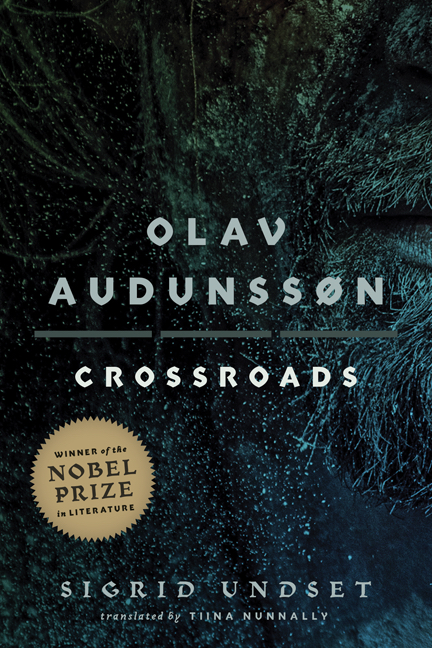
BOOK REVIEW: Olav Audunsson III: Crossroads by Sigrid Undset

 I received this book for free from Netgalley. That did not influence this review.

I’ve been following the story of Olav Audunsson (also known as The Master of Hestviken) in the new translation of Sigrid Unset’s masterpiece set in 13th-14th century Norway. (The translator is Tiina Nunnally.) The story is told in four volumes. I’ve read Book I: Vows and Book II: Providence, and reviewed them previously. The current book, Book III, is called Crossroads. I highly recommend reading them in order or the power of the story will be lost.


Book III continues seamlessly from where Book II ends. Olav is master of the profitable estate called Hestviken. He’s still young (late thirties), handsome, and healthy. However, he grieves the loss of his wife, Ingunn, who was the love of his life, despite their terrible experiences apart and together. Olav has resolved never to remarry or take a mistress because he still feels bound to her.

He has an heir, Eirik, who he has claimed as his own, although the child was fathered by a man who raped Ingunn. Eirik is growing to manhood. Although the reader can have flashes of sympathy for him, he’s not a likable boy. He’s given to whining, boasting, and lying. However, he senses that his father doesn’t like him – which is true – and that makes his desperate personality more understandable. Olav has never let on to anyone that Eirik is not his biological child. Even to himself, he accepts Eirik as his son. But there is also the question of his natural son, Bjorn, born to Torhilde, the woman who was once the housekeeper of the estate. Bjorn is a beautiful boy and Olav wishes he could have more to do with him than he does. 

Basically, Olav is a hot mess. He’s always been a deeply religious man, but he’s oppressed by the weight of his sins and wallows in conflicted feelings of unworthiness. He is deeply connected to his estate, but is bored by it. He mourns Ingunn, but still feels attracted to Torhilde. He leaves Hestviken for a short commercial voyage to London, during which he nearly sleeps with a very young married woman who reminds him of Ingunn. He has a religious experience and seriously considers becoming a monk. Yet throughout, he is incapable of making a significant change in his life and continues muddling along.

Eventually, war comes to his corner of the world and he sets off to take part. This reminds him of his soldiering days in his youth. He exhilarates in battle. He’s severely wounded. Good men are lost, but he survives and returns home. One expects that the clarity he felt in battle will not remain in peacetime, and he will return to his indecisiveness and wallowing.

It’s difficult to explain why this book is so compelling. Olav is not a particularly admirable character. In many ways, he’s rather weak. Still, the author gives such a convincing portrait of a medieval Norwegian “everyman” that I’m hooked. There is one more part to this quartet. I’m anxious to see how Olav’s story ends.

Sunday, December 12, 2021

BOOK REVIEW: Olav Audunsson II: Providence by Sigrid Undset

 I received this book for free from Netgalley. That did not influence this review.


I just finished reading Olav Audunsson Book II: Providence by Sigrid Undset, translated by Tiina Nunnally. What an extraordinary achievement this work is. When I was approved for this book, I also bought Book 1: Vows because I knew I should read it first. I’m glad I did. I don’t think this volume, as wonderful as it is, would stand on its own. To fully appreciate what these characters are going through, the backstory is needed. And the story is very well worth reading as a whole.

Providence picks up where Vows left off. The ill-fated young lovers, Olav and Ingunn, have finally been reunited after years and years of separation, guilt, and despair. They suffered extreme hardship due in large part due to cruelties of their families and society, but also due to their own small errors which were compounded by even greater sins. One thing kept leading to another in that book and they really did seem cursed by Fate. But they are now in a position to find that love will conquer all.

It does not.

Providence is a powerful and devastating book. Set in medieval Norway, the landscape is frozen and harsh. Men are dragged off to war by their kings for conflicts in which they have little stake. And God is ever present in their lives as a force that is more oppressive than hopeful. Reaching out for His grace has far-reaching consequences. Neighbors are far less forgiving than God.

Olav Audunsson is now master of a wealthy estate. He brings his wife Ingunn home. He fully intends to put the past behind them and forgive her completely. (She had a child during their years of separation, a son, born after an adulterous encounter that was less her fault than she believes it to be.) She’s unable to forgive herself. When she miscarries again and again, she comes to believe that it’s God’s punishment for her adultery and, more particularly, for abandoning her son. Olav is unable to bear her misery, so he goes and retrieves the boy from the foster parents, claiming him as his own.

This means the familial inheritance will go to an illegitimate heir who is not really Olav’s offspring. If Olav’s relatives ever found out, he’d be in big trouble for allowing the estate to pass outside the family line. It also means if Olav and Ingunn ever do have a son, he’ll take second place to the older boy. For all Olav insists it doesn’t matter to him, it does. He treats the boy as decently as he can, but he just doesn’t like him. And this drives even more of a wedge between him and his wife.

Ingunn is not the only one sunk in despair over a guilty conscience. There is also the matter of Olav’s crime. He murdered the man who seduced Ingunn and hid the evidence. All to protect her honor, of course. He grows increasingly desperate to make his peace with God but if he confesses, he’ll have to do penance, the truth will come out, and everything gained by the original secrecy will be lost. Ingunn and the boy will be harmed. Ingunn insists he can’t do that to her. So he continues to live with the unconfessed sin, growing more and more taciturn and withdrawn.

Ingunn is not a healthy woman to begin with and multiple miscarriages strip her of any strength she might have had. She’s also a terrible housekeeper/female head of an estate. The only time she shows any gumption is in defense of her son. She’s a shadow of her former self. She loses all her beauty. She’s a millstone around Olav’s neck. And yet, they still love each other with the fiercely strong remnants of their original love.

Things go from terrible to unbearable as Olav and Ingunn struggle with their despair. Every once in a while, Olav is overcome by religious conviction, but it’s leached away by Ingunn’s dependency and the knowledge that her ruined life is his fault.

This book is incredibly bleak, as this pared down plot summary shows. And yet it’s beautiful in its harsh way. The characters are so realistic, so human, that it’s impossible not to empathize with their pain.

I don’t know when Book 3 will be released but I’ll certainly read it, hoping things might turn around for Olav, but expecting they won’t.

Saturday, December 4, 2021

BOOK REVIEW: Matrix by Lauren Groff

I saw matrix by Lauren Groff was getting a lot of buzz in the historical fiction world. Then I read it was set in an abbey in medieval England, in the twelfth century. The protagonist, Marie, is an illegitimate noblewoman. Her father was Geoffrey Plantagenet, Count of Anjou, establishing a connection of sorts to Eleanor of Aquitaine. My favorite family in my favorite historical time period—I had to read it.


Marie is excessively tall, ungainly, unattractive, illegitimate, and poor. So, she is considered unmarriageable and therefore useless. However, because she has connections (Empress Mathilda and Eleanor) she is sent, at the age of seventeen, to an abbey to take over as prioress. Marie has no religious calling and no desire for this position. Worse, when she arrives, she discovers it is small, impoverished, and in the midst of a plague. 

Marie is headstrong, passionate, intelligent, and fierce (much like Eleanor, who she loves and idolizes.) The arc of the novel is the process by which Marie comes to terms with the life she will have to live and then turns the abbey into a monument of female empowerment. Marie is able to turn the abbey not only into an enormously prosperous one, but also a haven for women where they can thrive according to their talents. Marie is an ambitious, prideful woman, but she is also generous and loving. Her theology is unorthodox, to say the least, but her devotion to her charges is complete.

This is a powerful literary work with luminous prose that pulled me into the twelfth century. Marie is a woman of her time and ahead of her time. Highly recommended.

Friday, June 19, 2020

BOOK REVIEW: To Calais, in Ordinary Time by James Meek

James Meek is a difficult writer to read. I recently reviewed The People’s Act of Love and, although I struggled with the awfulness of the characters, it’s a story that stayed with me.

His current book, To Calais, in Ordinary Time, is another historical novel that is hard to read but rewarding to have read. Set in the fourteenth century during the Black Death, it’s particularly disturbing to tackle during the pandemic. The degree of superstition, denial, resignation, and grief feels suitable to the Middle Ages, which makes its parallels to today even more frightening and sad.

There are three protagonists, all starting from England where the plague is, initially, simply a rumor, who are heading to Calais for various reasons. In France, the plague is a deadly reality. As the protagonists move toward the disease, it comes to meet them.

Lady Bernadine is a young gentlewoman who is fleeing a marriage to an old man. The marriage was arranged by her widowed father who wants to exchange his daughter for that of his friend. Thus both old men can have pretty young wives. Berna, who yearns to model her life after the Romance, Roman de la Rose, was previously courted by a handsome young lord named Laurence Hacket. He asked for her hand, was refused, and left for his own estate near Calais–much to Berna’s chagrin. Since it didn’t occur to him to carry her off, she has decided to pursue him.

There is a young ploughman from the same village, Will Quate, who is in an uncomfortable half-free, half-serf position, whose greatest wish is to have his freedom recognized by the lord. To that end, he has trained as a bowman and has earned the chance to represent his lord by helping to garrison Calais. He leaves behind his betrothed, the village beauty, to whom he is not particularly attached. Along the way, he joins a band of archers who are every bit as awful as the soldiers in The People’s Act of Love.

Finally, there is a Scots proctor, schooled in Avignon, who is being sent back to France by his superiors. He will accompany the archers as a substitute for a priest, even though he insists he is not truly a priest and not qualified to hear confession or give last rites. (He hears quite a bit of confession.)

Even though the protagonists travel together, each a product of their time and place, they may as well be from different worlds. The author gives them each unique voices that add to the feeling of immersion into the fourteenth century. In many ways, they are as foreign to each other and unable to comprehend one another’s world views as they are foreign to the reader.

Ideas about war, sex, right and wrong, religion, and impending death are explored from the different perspectives of the protagonists and the characters they interact with. It’s fascinating to see how lines are blurred.

The novel is a slow read at first, but the tension builds. Even though I found the characters hard to like, it was still tragic to watch as the plague inexorably did its work.

Tuesday, September 10, 2019

BOOK REVIEW: A Matter of Interpretation by Elizabeth MacDonald

I received this book for free from Netgalley. This did not influence my review.

A Matter of Interpretation by Elizabeth MacDonald is meaty, in-depth historical fiction, recounting the life of a lesser known historical figure from the Middle Ages (my favorite time period). This rather somber tale is the type of historical fiction I love. The action is subdued, but the psychological picture of the man it portrays is vivid and compelling.

Canon Michael Scot was one of the most learned men in the court of Frederick II, the Holy Roman Emperor and King of Sicily, in the late twelfth and early thirteenth centuries. Scot was born in the wilds of Scotland (so he was always an outsider in the south) but he was educated in Paris, the foremost Christian intellectual center of the day. The depth and breadth of his learning was so impressive that he was chosen to be one of the young King Frederick’s tutors. Their relationship flourished over the years, fortunately for Scot, as the King/Emperor’s patronage not only allowed him to pursue studies in far-flung locations but also lent him protection when the subjects he chose to study offended the Church.

Scot was fascinated by philosophy, in particular Aristotle (unfortunately pagan) and the commentaries on Aristotle by Averroes (unfortunately Muslim). He lived for a time in parts of Spain under Islamic rule so that he could translate the Islamic studies into Latin. He studied not only philosophy, but mathematics, natural history, medicine and astrology. Although I usually find depictions of the occult distracting, the otherworldliness of Scot’s astrological predictions and their frightening accuracy fit in so well with the storyline that it was all believable.

Because of Scot’s knowledge of medicine and his skill in healing, the emperor chose him for his chief physician. Scot’s own medical and mental torments made him an even more sympathetic and interesting character.

Although he was a monk himself, his unorthodox interests and his close work with Muslims and Jews earned him the enmity of his fellow churchmen. His friendship with Frederick also made him a target for ambitious courtiers. His life was one long struggle to learn and to disseminate what he had learned, despite the opposition. The details of his studies seemed well-researched and were presented in enough detail to convince without becoming burdensome to read.

A Matter of Interpretation takes us into Canon Scot’s world with all its intrigues, prejudices, and opportunities. The author does a superb job of bringing Michael Scot to life and pulling the reader into the story. I’ll be looking for more by this author!

Saturday, August 11, 2018

BOOK REVIEW: In the Presence of Evil by Tania Bayard

Christine de Pisan, a brilliant medieval lady of letters, is the heroine of a new historical mystery series. I reviewed the book for the Historical Novels Review (e-galley of book received from Netgalley.) 


See my review here.

Tuesday, November 22, 2016

BOOK REVIEW: Ivanhoe by Sir Walter Scott

I’m a devoted fan of medieval romance, so I’ve no excuse for not having read Ivanhoe by Sir Walter Scott before now. Fortunately, I chose it for my nineteenth-century classic for the Back-to-the-Classics Challenge, and I’m making a last-ditch effort to get all twelve books read. (Now just two to go!)

I’ve read Scott before, Waverly and The Heart of Midlothian, and while I admired the author’s skill and enjoyed both books, they were a bit dated in terms of readability. So I approached Ivanhoe with some trepidation. And it does start off slowly. We are introduced first to a variety of peripheral characters with the principals shrouded in mystery. The reader has to be patient to get into the actual tale.

The hero of the story, Wilfred of Ivanhoe, is a young Saxon knight who served King Richard on Crusade, much to the annoyance of his father, Cedric, an old-blood Saxon nobleman who despises the Normans on principle as well as for good reasons. (Prince John is causing mischief in England, proving that the Normans are no good.) Cedric has a good friend, Athelstane, who is the last in the line of old Saxon kings. And he has a beautiful ward, the Lady Rowena, who is descended from King Harold. He wants them to wed and found a new dynasty to throw off the Norman oppressors. The fact that Rowena and Wilfred are in love is an obstacle to Cedric’s plans, so he disinherits his son. That’s the backstory.

Now, Wilfred returns in disguise. He comes partly to show Rowena he is still alive and still faithful. But he’s also staying more or less close to his king, who has returned from the Crusade after being freed from captivity in Austria. Richard has come to reclaim England from John. He’s also disguised and traveling in secret until he can amass his followers.

In addition, the reader meets Isaac of York and his beautiful daughter, Rebecca. They are Jews, and much of the plot revolves around the persecution of Jews as well as their avarice and wealth. Scott manages to both expose the bigotry of the times and to reinforce the stereotypes, which makes this part of the book doubly disturbing.

The good guys (the Saxons, Richard the Lionheart, and Robin Hood) must contend with the powerful bad guys (the Knights Templar and the barons supporting John.)  There are sieges, battles, tournaments, and ambushes as well as knights courting their ladies. The adventures pile one on another, interspersed with the narrator’s commentary. It’s great fun, especially with the witticisms of Cedric’s jester and Friar Tuck added in.

I can understand why Ivanhoe is one of Scott’s best known and most popular books. For old fashioned medieval adventure, it’s truly a classic.

Saturday, October 22, 2016

BOOK REVIEW: Chivalry and the Medieval Past edited by Katie Stevenson and Barbara Gribling

I received this book for free from Netgalley. This did not influence my review.

I love medieval history. While I mainly stick to biography and straightforward narrative history of particular events or time periods, every once in a while I like to wade through the weeds of more academic history.

Chivalry and the Medieval Past, edited by Katie Stevenson and Barbara Gribling, is a multi-author collection of essays examining how chivalry is and has been interpreted and how those interpretations influence visions of medieval culture. It seems that as soon as the Middle Ages ended, people were already looking back at it with either nostalgia or disdain. The militarism inherent in the word "chivalry" was either romanticized as a manly virtue or criticized as barbaric.

The contents of the book are as follows:

Introduction: Chivalry and the Medieval Past - Katie Stevenson and Barbara Gribling
'An Institution Quite Misunderstood': Chivalry and Sentimentalism in the Late Scottish Enlightenment
- David W. Allan
Creating a 'Medieval Past' for the Swedish Orders of Knighthood - Antti Matikkala
'Hung Round with the Helmets, Breast-Plates, and Swords of our Ancestors': Allusions to Chivalry in Eighteenth-Century Gothicism - Peter N. Lindfield
Knights on the Town? Commercial and Civic Chivalry in Victorian Manchester - Rosemary A. Mitchell
'The Dark Side of Chivalry': Victory, Violence and the Victorians - Barbara Gribling
Daze and Knights: Anachronism, Duelling and the Chivalric Ethic in Nineteenth-Century Italy - Steven C. Hughes
The German Crusade: The Battles of Tannenberg, 1410 and 1914 - Stefan Goebel
'Hark ye back to the age of valour': Re-enacting Chivalry from the Eglinton Tournament to Kill Streak - Paul Pickering

While not every topic will appeal to every reader interested in medieval studies, nevertheless I recommend reading them all, since you might be surprised by which essay ends up grabbing you.

There is something interesting to find in each of the chapters, which cover topics ranging from the construction of a medieval past to lend legitimacy to newly established orders of knighthood in Sweden, to the pros and cons of Gothic architecture versus classical architecture in England, to the widespread popularity of historical re-enactment with its claims of increasing historical knowledge, not just providing entertainment. And while the analyses can be ponderous at times, the individual essays were varied enough to create a very readable whole. For those interested in an exploration of how perceptions of the middle ages are always evolving, this book is worth a look.

Sunday, July 17, 2016

BOOK REVIEW: The Passion of Dolssa by Julie Berry

The Passion of Dolssa by Julie Berry was very favorably reviewed on a blog I follow and, because it is set in my favorite historical place and time, I squeezed it onto my to-be-read list. What a rewarding read!

Dolssa is a young Christian mystic, a noblewoman who has found an intimate relationship with Jesus during a time when any sort of religious aberration is suspect. She living in Provence, Provensa, in the mid-thirteenth century, just after the Albigensian Crusades. Inquisitors are bent on rooting out any last remnants of "heresy." Although they are specifically hunting Goodmen and Goodwomen (Cathars), they will not let a girl who claims to speak directly with Christ slip from their hands.

Dolssa is sentenced to be burned on the pyre. However, she makes a miraculous escape and flees. Life on the run is difficult for a naive gentlewoman. She’s found near dead, hidden next to a river, by a peasant woman named Botille.

Botille is the true heroine of the story. She and her two sisters are relative newcomers to a small town, Bajas, where they renovated an old tavern and made a place for themselves. With their hard work and unique talents, they have become favorites there, but are not so well-loved that they can bring a heretic, one being pursued by Inquisitors, boldly into Bajas. Anyone who shelters or aids a heretic is subject to the same punishment as the supposedly guilty one: execution, sometimes preceded by torture.

At first, the sisters try to hide Dolssa, but this becomes impossible as she starts healing the sick of the town. Word of a holy woman spreads.

Botille has many friends in Bajas, but finds them pulling away as the danger increases. It’s only a matter of time before the Inquisitors track Dolssa down. Botille’s one steady support (in addition to her sisters) is a man she finds rude and churlish. Still, without his support she’d be in even worse straits. When the Inquisitors do come, Botille (and her sisters, and Dolssa, and the rude young man) risk losing all.

The novel is difficult to put down. Written in a style that pulls you into medieval Provence, it’s pensive without being slow. The voices of the characters are distinctive and convincing, and the sympathetic heroines have you rooting for an outcome that circumstances are unlikely to allow. The setting is vividly described.

This is my favorite kind of historical fiction. A historical note, glossary, and reading lists at the end of the novel demonstrate the thoroughness of the research behind the story, and the author leaves to the reader the choice of how much of the tale is to be believed.

Monday, February 1, 2016

BOOK REVIEW: The Lion and the Cross. A Novel of Saint Patrick and Ancient Ireland by Joan Lesley Hamilton

Disclaimer: I received this book free from Netgalley. This did not influence my review.

First published in 1979, The Lion and the Cross: A Novel of Saint Patrick and Ancient Ireland by Joan Lesley Hamilton has been re-released by Open Road. Generally, I’m a big fan of historical novels written back in those days (how long ago the 70's seem!) and Saint Patrick is an ideal protagonist, so I was happy for the opportunity to review this book.

Patrick (Padraic) is an old man of forty, looking back on his life, as the prologue opens the story. This device allows the older but wiser man to pass judgement on his younger self and thereby mitigates some of the judgement the reader might want to pass upon him. Young Patrick was not a likeable guy. Spoiled, rebellious, too sure of himself, and an avowed atheist (in defiance of his very religious parents), the youth is running amok himself on the day barbarian raiders from Eire sweep through his village, looting and pillaging. He returns just in time to stumble upon the raiders, who cart him back to their homeland to be a slave.

His stubborn defiance serves him well in some ways, but he is slow to see or accept the workings of God in his life. Eventually, he rises to a position of some prominence in the court of a powerful king, a warlord, though it is always understood he is a slave. He wears his Christianity as a symbol of his defiance, and takes a good deal of pride in the superiority of his God and therefore himself. Always, Patrick is certain of what God wants for him and what God surely must not want, and when those expectations don’t correspond with current reality, Patrick’s response is anger or doubt. The miracles God works through him and the visions Patrick is sent, even the voice of God speaking to him directly, each only temporarily convince Patrick that God is, in fact, with him. This is understandable enough as Patrick’s life is extremely challenging. But his vacillation gets a bit wearying and his arrogance makes him an unappealing protagonist. These things make the story more difficult to read, even if this realistic approach is ultimately rewarding.

It takes the remainder of his youth and many bitter adventures before God humbles Patrick to the point where he can be a useful servant. The novel ends before Patrick returns as a missionary to Ireland, but the fact that he will do so is no longer in doubt.

I had a mixed reaction to this book. The story is interesting and a credible representation of a life that is poorly documented. The author does a good job of creating a life story from the few facts and the legends that have sprung up around him. She also does a wonderful job of making Ancient Ireland and Briton vivid and real. The key events in Patrick’s fictional life are compellingly presented. However, there is a lot of wandering in the wilderness for this lost young man, a lot of soul-searching and backsliding. I found myself skimming over parts of it, just enough to get the gist of what was going on, as I got bogged down in the sometimes over-written prose. It was difficult to connect with the other characters, despite finding them convincingly portrayed, because Patrick himself doesn’t connect in lasting or meaningful ways. His friendships are fairly shallow, because he is always angry and superior. His relationships with women are not relationships, but rather he lusts after or condescends to them, worships or hates them. He never really sees them as people.

For historical fiction fans who are interested in this Dark Ages time period and/or those with an interest in great historical religious figures, this re-release is worth a look.

Saturday, December 12, 2015

BOOK REVIEW: The Wake by Paul Kingsnorth

I heard the buzz a few months ago about the newly released (in the U.S.) historical novel The Wake by Paul Kingsnorth and put it in the "must read" category. Having just completed it (explanation to follow) I have to agree with all the superlatives that have been flung at it. This is a truly original and astounding work of art.

The novel, a tale of England in the days of the Norman Conquest, is narrated by Buccmaster of Holland, a small freeholder whose grandiose self-importance is not supported by any actual influence in his tiny hamlet. When the wars start and England is swarmed by Normans, Buccmaster’s world is destroyed. He becomes a guerilla warrior of sorts, the self-proclaimed leader of a reluctant band of men as broken and defeated as he is.

I had anticipated a more inspiring story of resistance against oppression. But Kingsnorth is more inventive than that. He gives us a painful, horrifying story of violence, selfishness, and hopelessness.

Not content with providing a brilliant account of a frustrated and rather depraved anti-hero, an unreliable narrator whose true nature is slowly revealed over the course of the book, Kingsnorth is determined to immerse the reader fully. For that, he needed to use language appropriate to the time. It was not enough to weed out modernisms, because all our language is too modern. He invented an Old English shadow language and put the whole narration in the mouth of the protagonist. This is a difficult book to read, but worth every bit of the effort.

So here’s my confession. The effort was not mine. We read the book as our family read-along choice. At this point in the evolution of our family’s evening reading-together-time, this means that my husband read the book aloud to me and my teenaged son. (The language got a bit uncomfortable, but it isn’t like my son doesn’t hear worse at school.) Hearing the book is a wonderful way to fall into the rhythm of the language. It took a short while for the pronunciation to gel, and for us to grasp the meaning of the unfamiliar or vaguely familiar words, but once accustomed to Buccmaster’s voice, it became easy to slide into this world that was at once surreal and all too real.

For literature lovers, historical fiction and history fans, this book should be on the must-read lists.


Monday, October 5, 2015

BOOK REVIEW: Sir Nigel by Sir Arthur Conan Doyle

Hurray! I’ve completed another book for the Back-to-the-Classics challenge. This time, it was the Forgotten Classic, defined as: a lesser known work by a famous author or a classic that no one reads anymore. I think my choice, Sir Nigel by Sir Arthur Conan Doyle, fits the bill either way.

Doyle is, of course, the author of the Sherlock Holmes detective stories. However, he had a lot of other literary credits to his name, including seven historical novels (which he and many critics consider to be his best work.)

Sir Nigel, loosely based on the English knight Nigel Loring, is set during the early years of the Hundred Years War (appx 1350.) It follows the career of the gallant Squire Nigel Loring, an impoverished gentleman whose family lands have nearly all been stolen away by a neighboring abbey. Nigel lives with his aged mother, a formidable woman who has brought him up with the old ideals of chivalry. After a series of adventures, proving what a capable and romantic figure he is, he’s plucked up by one of King Edward’s best knights to be his squire. Nigel is to follow him off to war against the French.

After saying his farewells to a neighbor’s daughter, a serious, loyal damsel who loves him well, he pledges to return home to marry her. She doesn’t want to tie him down or hold him back, but he turns that to advantage by promising to do three honorable deeds proving his worth, entirely for her.

There are more adventures all along the way, and Nigel rises in the king’s favor as he completes more and more bold deeds. He is always chivalrous and true to his nature, sometimes impetuous to the initial dismay of knights around him, but he always prevails.

The novel is written as an old-fashioned romantic adventure, sounding in tone like medieval knights-of-yore stories. It is episodic, one thing after another, with the overarching goal to be to complete the three deeds, above and beyond the call of duty, to prove his honor and win his love. The story is battle-heavy and occasionally tension-filled, but there is never really doubt that he’ll succeed. Even when the action is not particularly realistic, it’s entertaining.

Several years ago, I was looking for medieval-type non-fantasy historical fiction for my son, who loved that kind of thing. This would have been a great one for him then. I fear he may be a bit too cynical for it now. But I recommend it for its innocent look at the notion of chivalry.

Wednesday, April 22, 2015

BOOK REVIEW: A Great and Terrible King. Edward I and the Forging of Britain by Marc Morris

Browsing in the bookstore a while back, in the nonfiction/biography section, I happened across A Great and Terrible King. Edward I and the Forging of Britain by Marc Morris. I came SO close to buying it, because I really did want to read, as its jacket blurb pronounced it: "A major biography of a truly formidable king, whose reign was one of the most dramatic and important of the entire Middle Ages, leading to war and conquest on an unprecedented scale." The book has an eye-catching cover, too. A headless man–mimicking all the headless historical women covers that were so popular not so long ago!

I really don’t know enough about Edward I (1239-1307), king of England (1272-1307), nicknamed Longshanks and Hammer of the Scots. However, since I still have a stack of biographies already purchased on people I’d like to know more about, I reluctantly put the book back on the shelf. But it kept nagging at me. So I did the next best thing and got it out from the library. With a due back date soon and a long car ride last weekend, not to mention the nonfiction challenge, the book was bumped to the top of my TBR list.

And I’m so glad I read it.

Edward I is a fascinating king who lived through a tumultuous period in medieval history (aren’t they all?) who is credited with shaping Britain into what it is today. He was, at least as emphasized in this book, a warrior king, fighting someone or another throughout his reign. He conquered/annexed Wales and attempted to do the same with Scotland. (He is the king who fought William Wallace and Robert Bruce–think Braveheart.) He also went on Crusade and scuffled with France. While his subjects resented all this because of the constant demands for men, money, and resources, they nevertheless considered him a great king because of it.

So, was he a great and terrible king? I initially thought the title was one of admiration and the term "terrible" had more of a connotation of "one who inspires terror." Sort of more along the lines of "awesome." But as I read, I realized that no, he was actually terrible.

Who was Edward and what did he accomplish? Did he forge a united, national identity? Did he strengthen the legal system? Was he pious? Etc. Etc.? Or was he a greedy, grasping, bigoted war-monger whose loyalty was questionable and whose word could not be trusted, who left his kingdom bled dry?

The book follows Edward’s career chronologically, which I liked. It was a logical, linear presentation of the history. It’s a compact account, only 378 pages with the notes, bibliography, and index bringing it up to 462. So history buffs who are well-acquainted with Edward and his friends and foes will no doubt find that things were left out or dealt with only superficially. But for people like me who wanted to get Edward more firmly set in their minds and arrange the medieval puzzle pieces around him, this was the perfect book.

Sunday, February 22, 2015

BOOK REVIEW: Medieval Tastes. Food, Cooking, and the Table by Massimo Montanari

Disclaimer: I received this book for free from Netgalley. This did not influence my review.

Medieval Tastes. Food, Cooking, and the Table by Massimo Montanari is an interesting exploration of food in the Middle Ages from a cultural perspective. It’s a very academic book, looking at food both figuratively and literally, discussing theories of taste and medieval attitudes about mixing types of food for optimal balance (fat and lean, sweet and sour, etc.)

This was not the book I thought it would be–my fault, not the book’s–and so I was a bit disgruntled as I set forth reading what seemed to be a lot of theoretical discussion that wasn’t giving me a lot of "actual" information. I was hoping for something more straightforwardly encyclopedic (for research for my own historical novel writing): these foods were available here, during these time periods, prepared in this fashion, eaten like this. This is not that book. There are some sweeping generalizations about what was eaten, but that information was nothing new. The focus is mostly on the later Middle Ages. And the author concentrates largely on regions in Italy. He’s using medieval cookbooks from these times and regions to build his case.

But, once I let go of what it was I wanted from a book about medieval food and read the book the author had actually written, I was able to appreciate that this is an interesting text. I particularly liked the central portion of the book where he talks about different categories of food: meat, fish, milk/cheese, bread, water, and wine and elaborates on the evolution of each in the diet–availability and symbolism. There is also a section on the fork versus eating with hands and a discussion of medieval manners.

So, overall, this book is an interesting look at culinary history, or perhaps, historical food theory, but be aware going in that it is not a narrative history of medieval food.

This is my second nonfiction book for the nonfiction challenge.

Tuesday, January 27, 2015

BOOK REVIEW: Gutenberg's Apprentice by Alix Christie

I’ve just finished reading a spellbinding historical novel: Gutenberg’s Apprentice by Alix Christie. Rather than another story of a literary genius (or writer’s significant other) as I usually like to read, this book pays homage to a great man to whom all lovers of the written word owe an unimaginable debt. Of course, we all "know"Johann Gutenberg, the inventor of mechanical movable type, or the printing press. He’s responsible for the Gutenberg Bible, which I guess I always learned was the first book to ever be printed using a printing press. It seems that historical factoid is an oversimplification, naturally. I never actually gave much thought to what an innovation "movable type" was, or how extraordinary an undertaking printing a book, any book, must have been.

Gutenberg was a genius.

But this isn’t his story. Not entirely.

Whenever we think of lone geniuses succeeding at overcoming insurmountable obstacles to achieve things that no mere mortals have ever done before, chances are they didn’t do it alone after all.

Gutenberg’s printing press was a team effort. One of the major players was a man named Peter Schoeffer. He had two recommendations for the job of apprentice. First, he was an accomplished scribe. Second, his adoptive father, Johann Fust, was very rich and very ambitious. Gutenberg needed financial backing.

Peter is a remarkable hero. Strong, thoughtful, loyal, devoted, religious, and extraordinarily intelligent, he is appalled, at first, by the very idea of a printing press. He loves his chosen career, being a scribe, and had high hopes for advancement. He can see how such an invention would destroy the very world he knows. It would take the beauty of the written word, the art of it, and make it hollow and empty.

And yet. . .he owes Fust too much to disappoint him. And as he works with Gutenberg, he comes to respect him as well and to appreciate what Gutenberg is trying to accomplish. As he invests his own talents into the process, improving it, making it into an art form of its own, Peter begins to feel that this is something God has put him on earth to do.

I wouldn’t necessarily have thought that descriptions of the grind of making a printing press from scratch, when none of the parts had ever even been put to such a particular use before, would have been not just interesting, but compelling. They needed to get the ink right, the letters cast from the right metals, the right project, enough letters, the right letter shapes, enough people to work the presses–there was a constant need for more money. There were political and religious forces arrayed against them. The whole thing had to be done with utmost secrecy. The Infidels took Constantinople, necessitating another Crusade! And all the while, they had to race to get the Bible printed before the tenuous partnership tore itself apart.

Christie gets at the heart of the personalities of these driven men, managing to humanize them despite the remarkable level of historical detail. Peter is the one who holds everything together, driving the work to continue, but he’s the one who suffers the most from emotional strain because he continues to care about the people involved, right until the end. The making of ‘The Book’ is fascinating, the making of the man, Peter Schoeffer, is even more so.

Today, when we can do so much with a computer and printer, it’s hard to imagine what it must have been like for every page, every image, to have to have been created by hand. What a monumental leap of imagination and faith it was to go from that to mechanical printing. I suppose I knew that, but without actually giving it the thought it deserves until reading Gutenberg’s Apprentice.

Tuesday, December 16, 2014

BOOK REVIEW: The Towers of Tuscany by Carol M. Cram

Most of the medieval historicals I read are set in England or France, so I was excited to get my hands on this review copy of Carol M. Cram’s wonderful novel set in Italy in the 1300s: The Towers of Tuscany.

Disclaimer: I received this ebook for free from Netgalley. This did not influence my review.

Sofia Carelli is the talented daughter of a painter, Maestro Antonio Barducci. Having had no son, he passed on his skills to his daughter–not exactly the wisest move, since it is apparently forbidden for a woman to engage in a commercial artistic endeavor. Had she hidden away in her father’s home, she might have continued to work for him in secret, but she was a beautiful and willful young lady, who fell in love with a handsome, charming young man.

Sofia gets her way. (Sofia always gets her way.) She and Giorgio Carelli were married, against her father’s better judgement. It didn’t take long for Sofia to regret her choice. Giorgio drinks and gambles. And if he knew she snuck away to the tower in their home to paint, he would punish her severely.

The marriage is a disaster, but things get worse when her father dies during a fracas at a wedding feast. (Medieval Italy=dangerous family rivalries.) Giorgio is partly to blame for the fracas. Before dying, Sofia’s father commands her to take a panel she has painted and go to Siena to seek out a friend of his, who will take her in and help her continue her work.

It’s no mean feat to run away from your husband. And it’s no more permissible in Siena for a woman to work as a painter than it is in San Gimignano (Sofia’s hometown.) But Sofia is willing to undertake any hardship, accept any risk, in order to paint.

This is a vividly written story of a headstrong woman determined to follow her muse. She refuses to be bound by the conventions of her time. She’s also a passionate woman with an eye for a handsome face. So in spite of the fact that she tells herself she won’t make the same mistake twice. . .

The storyline is compelling and the details of each of the settings and particularly of the work of painting made this a particularly enjoyable read. I could have some sympathy for Sofia; she was trapped in a time and place where it was impossible to reconcile what she wanted to do with the options available to her. However, although I understood what she was up against and admired her talent, I couldn’t like Sofia. Her arrogance I could accept. Her high opinion of her art was deserved since she was not the only one praising it. But her blithe disregard for anyone else’s feelings, the excuses she made for the hurt she caused, and her willingness to put others in danger so that she could paint made me sympathize more with her friends and family. And yet. . .aren’t great artists always self-centered like that? Still, it isn’t necessary to like Sofia to love this book. There are characters enough to admire in The Towers of Tuscany.