Showing posts with label thirteenth century. Show all posts

Sunday, December 3, 2023

BOOK REVIEW: Olav Audunsson IV: Winter by Sigrid Undset

I received this book for free from Netgalley. That did not influence this review.


The fourth and final novel in Sigrid Undset’s masterpiece of historical fiction, Olav Audunsson IV: Winter (translated by Tiina Nunnally) has recently been released. I really can’t praise this quartet enough. Please read the series in sequence — I: Vows, II: Providence;III: Crossroads, and finally, IV: Winter. This new translation manages to be both spare and beautiful.

The novels are set in 13th-14th century Norway, a generation before Undset’s Nobel Prize-winning Kristin Lavransdatter.

The story follows the life of Olav Audunsson from childhood until death. He is a God-fearing man. He inherits property and eventually becomes a wealthy, respected member of his community. And his whole life is centered (for good and bad, mostly bad) around his undying love for his childhood friend, Ingunn Steinfinnsdatter. Everything happens that one might expect: death of parents, unwise premarital sex, exile, war, murder, unfaithfulness, reconciliation, marriage, birth of children, death of children, estrangements, and religious agony and ecstasy. Even so, it is in many ways a quiet book, with more happening internally than externally.

The tragedy of Olav’s life rivals that of any Greek tragedy. The cascading misfortunes that follow youthful errors haunt him his entire life. His sins are visited upon his children. He is unhappy throughout his life and his actions cause others misery as well. And yet, for all my frustration with him, I also had enormous empathy for him. This medieval man truly lives and breathes on these pages.

Saturday, October 29, 2022

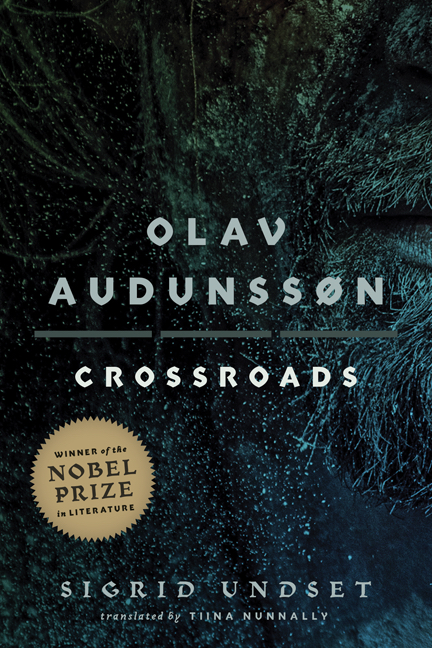
BOOK REVIEW: Olav Audunsson III: Crossroads by Sigrid Undset

 I received this book for free from Netgalley. That did not influence this review.

I’ve been following the story of Olav Audunsson (also known as The Master of Hestviken) in the new translation of Sigrid Unset’s masterpiece set in 13th-14th century Norway. (The translator is Tiina Nunnally.) The story is told in four volumes. I’ve read Book I: Vows and Book II: Providence, and reviewed them previously. The current book, Book III, is called Crossroads. I highly recommend reading them in order or the power of the story will be lost.


Book III continues seamlessly from where Book II ends. Olav is master of the profitable estate called Hestviken. He’s still young (late thirties), handsome, and healthy. However, he grieves the loss of his wife, Ingunn, who was the love of his life, despite their terrible experiences apart and together. Olav has resolved never to remarry or take a mistress because he still feels bound to her.

He has an heir, Eirik, who he has claimed as his own, although the child was fathered by a man who raped Ingunn. Eirik is growing to manhood. Although the reader can have flashes of sympathy for him, he’s not a likable boy. He’s given to whining, boasting, and lying. However, he senses that his father doesn’t like him – which is true – and that makes his desperate personality more understandable. Olav has never let on to anyone that Eirik is not his biological child. Even to himself, he accepts Eirik as his son. But there is also the question of his natural son, Bjorn, born to Torhilde, the woman who was once the housekeeper of the estate. Bjorn is a beautiful boy and Olav wishes he could have more to do with him than he does. 

Basically, Olav is a hot mess. He’s always been a deeply religious man, but he’s oppressed by the weight of his sins and wallows in conflicted feelings of unworthiness. He is deeply connected to his estate, but is bored by it. He mourns Ingunn, but still feels attracted to Torhilde. He leaves Hestviken for a short commercial voyage to London, during which he nearly sleeps with a very young married woman who reminds him of Ingunn. He has a religious experience and seriously considers becoming a monk. Yet throughout, he is incapable of making a significant change in his life and continues muddling along.

Eventually, war comes to his corner of the world and he sets off to take part. This reminds him of his soldiering days in his youth. He exhilarates in battle. He’s severely wounded. Good men are lost, but he survives and returns home. One expects that the clarity he felt in battle will not remain in peacetime, and he will return to his indecisiveness and wallowing.

It’s difficult to explain why this book is so compelling. Olav is not a particularly admirable character. In many ways, he’s rather weak. Still, the author gives such a convincing portrait of a medieval Norwegian “everyman” that I’m hooked. There is one more part to this quartet. I’m anxious to see how Olav’s story ends.

Sunday, December 12, 2021

BOOK REVIEW: Olav Audunsson II: Providence by Sigrid Undset

 I received this book for free from Netgalley. That did not influence this review.


I just finished reading Olav Audunsson Book II: Providence by Sigrid Undset, translated by Tiina Nunnally. What an extraordinary achievement this work is. When I was approved for this book, I also bought Book 1: Vows because I knew I should read it first. I’m glad I did. I don’t think this volume, as wonderful as it is, would stand on its own. To fully appreciate what these characters are going through, the backstory is needed. And the story is very well worth reading as a whole.

Providence picks up where Vows left off. The ill-fated young lovers, Olav and Ingunn, have finally been reunited after years and years of separation, guilt, and despair. They suffered extreme hardship due in large part due to cruelties of their families and society, but also due to their own small errors which were compounded by even greater sins. One thing kept leading to another in that book and they really did seem cursed by Fate. But they are now in a position to find that love will conquer all.

It does not.

Providence is a powerful and devastating book. Set in medieval Norway, the landscape is frozen and harsh. Men are dragged off to war by their kings for conflicts in which they have little stake. And God is ever present in their lives as a force that is more oppressive than hopeful. Reaching out for His grace has far-reaching consequences. Neighbors are far less forgiving than God.

Olav Audunsson is now master of a wealthy estate. He brings his wife Ingunn home. He fully intends to put the past behind them and forgive her completely. (She had a child during their years of separation, a son, born after an adulterous encounter that was less her fault than she believes it to be.) She’s unable to forgive herself. When she miscarries again and again, she comes to believe that it’s God’s punishment for her adultery and, more particularly, for abandoning her son. Olav is unable to bear her misery, so he goes and retrieves the boy from the foster parents, claiming him as his own.

This means the familial inheritance will go to an illegitimate heir who is not really Olav’s offspring. If Olav’s relatives ever found out, he’d be in big trouble for allowing the estate to pass outside the family line. It also means if Olav and Ingunn ever do have a son, he’ll take second place to the older boy. For all Olav insists it doesn’t matter to him, it does. He treats the boy as decently as he can, but he just doesn’t like him. And this drives even more of a wedge between him and his wife.

Ingunn is not the only one sunk in despair over a guilty conscience. There is also the matter of Olav’s crime. He murdered the man who seduced Ingunn and hid the evidence. All to protect her honor, of course. He grows increasingly desperate to make his peace with God but if he confesses, he’ll have to do penance, the truth will come out, and everything gained by the original secrecy will be lost. Ingunn and the boy will be harmed. Ingunn insists he can’t do that to her. So he continues to live with the unconfessed sin, growing more and more taciturn and withdrawn.

Ingunn is not a healthy woman to begin with and multiple miscarriages strip her of any strength she might have had. She’s also a terrible housekeeper/female head of an estate. The only time she shows any gumption is in defense of her son. She’s a shadow of her former self. She loses all her beauty. She’s a millstone around Olav’s neck. And yet, they still love each other with the fiercely strong remnants of their original love.

Things go from terrible to unbearable as Olav and Ingunn struggle with their despair. Every once in a while, Olav is overcome by religious conviction, but it’s leached away by Ingunn’s dependency and the knowledge that her ruined life is his fault.

This book is incredibly bleak, as this pared down plot summary shows. And yet it’s beautiful in its harsh way. The characters are so realistic, so human, that it’s impossible not to empathize with their pain.

I don’t know when Book 3 will be released but I’ll certainly read it, hoping things might turn around for Olav, but expecting they won’t.

Thursday, August 5, 2021

BOOK REVIEW: Olav Audunsson. I. Vows by Sigrid Undset, translated by Tiina Nunnally

Nobel-prize winning Sigrid Undset is best known for her three-volume novel of medieval Norway, Kristin Lavransdatter, published in 1920-1922. Less well known is her four-volume epic, The Master of Hestviken, otherwise known as Olav Audunsson. It’s also set in medieval Norway, but in the late 13th and early 14th centuries, a generation before Kristin Lavransdatter.

Tiina Nunnally has undertaken a new translation of the masterwork. The first volume, Vows, was published last year.

In this superb historical novel, we meet Olav Audunsson as a boy on the verge of manhood, living with his foster family, a family headed by Steinfinn Toresson. He’s treated with a benign neglect alongside the children of the family. Steinfinn and his wife have other problems and don’t pay much attention to what the children are getting up to.

What makes Olav unique is his bond with the eldest daughter, Ingunn Steinfinnsdatter. When they were children, the two fathers betrothed them in a silly ceremony while drunk. There has been a general acceptance of the betrothal ever since, though no one takes it very seriously except the children themselves. They grow from playmates to best friends. Neither ever questions the belief that they will spend the rest of their lives together.

Olav reaches adolescence. He’s only a year older than Ingunn, but his hormones kick into gear. She adores him, trusts him completely, and is frighteningly innocent. After a critical battle in the adult world, one in which Olav takes part, there is much celebratory drinking and carousing, and Olav and Ingunn slip away and consummate their betrothal. Not a good idea.

Olav is years away from his majority. Ingunn is only about 15. Had the foster parents lived, the marriage might have been rushed ahead, validating the union. But Steinfinn dies of his battle wounds and his wife precedes him, dying rather mysteriously. Ingunn is now a ward of her uncles, who see her as too valuable to give to Olav who, though he may have property to inherit, has no important political connections. Thinking to improve his chances of gaining the bride he thinks of as rightfully his, Olav confesses to the local bishop that he and Ingunn have already slept together. Things go from bad to worse.

The two are parted for years while Olav tries to earn enough clout to claim Ingunn. The unfortunate Ingunn is shelved in a remote estate with an elderly aunt and even more elderly grandmother. It’s a frustrating existence for Olav and a stultifying one for poor Ingunn. 

The novel delves deep into the customs and beliefs of the times. It immerses the reader in the rhythms of their daily lives and the passing of years. It shows how lives are altered by unwise choices and how one mistake compounds another. And yet, through it all, there is a beauty in the love of this pair for one another. It is, according to the author, “the simple story of a man and the people who intervene in his life.” It is that, though Olav was much more active in shaping his own life than Ingunn was allowed to be. Her passivity is painful to a modern reader, but faithful to the historical reality, which makes the novel all that more compelling.

This is gorgeous, epic, old-fashioned historical fiction, in a beautifully fluid translation. I’m looking forward to continuing the saga in book 2.

Tuesday, September 10, 2019

BOOK REVIEW: A Matter of Interpretation by Elizabeth MacDonald

I received this book for free from Netgalley. This did not influence my review.

A Matter of Interpretation by Elizabeth MacDonald is meaty, in-depth historical fiction, recounting the life of a lesser known historical figure from the Middle Ages (my favorite time period). This rather somber tale is the type of historical fiction I love. The action is subdued, but the psychological picture of the man it portrays is vivid and compelling.

Canon Michael Scot was one of the most learned men in the court of Frederick II, the Holy Roman Emperor and King of Sicily, in the late twelfth and early thirteenth centuries. Scot was born in the wilds of Scotland (so he was always an outsider in the south) but he was educated in Paris, the foremost Christian intellectual center of the day. The depth and breadth of his learning was so impressive that he was chosen to be one of the young King Frederick’s tutors. Their relationship flourished over the years, fortunately for Scot, as the King/Emperor’s patronage not only allowed him to pursue studies in far-flung locations but also lent him protection when the subjects he chose to study offended the Church.

Scot was fascinated by philosophy, in particular Aristotle (unfortunately pagan) and the commentaries on Aristotle by Averroes (unfortunately Muslim). He lived for a time in parts of Spain under Islamic rule so that he could translate the Islamic studies into Latin. He studied not only philosophy, but mathematics, natural history, medicine and astrology. Although I usually find depictions of the occult distracting, the otherworldliness of Scot’s astrological predictions and their frightening accuracy fit in so well with the storyline that it was all believable.

Because of Scot’s knowledge of medicine and his skill in healing, the emperor chose him for his chief physician. Scot’s own medical and mental torments made him an even more sympathetic and interesting character.

Although he was a monk himself, his unorthodox interests and his close work with Muslims and Jews earned him the enmity of his fellow churchmen. His friendship with Frederick also made him a target for ambitious courtiers. His life was one long struggle to learn and to disseminate what he had learned, despite the opposition. The details of his studies seemed well-researched and were presented in enough detail to convince without becoming burdensome to read.

A Matter of Interpretation takes us into Canon Scot’s world with all its intrigues, prejudices, and opportunities. The author does a superb job of bringing Michael Scot to life and pulling the reader into the story. I’ll be looking for more by this author!

Sunday, July 17, 2016

BOOK REVIEW: The Passion of Dolssa by Julie Berry

The Passion of Dolssa by Julie Berry was very favorably reviewed on a blog I follow and, because it is set in my favorite historical place and time, I squeezed it onto my to-be-read list. What a rewarding read!

Dolssa is a young Christian mystic, a noblewoman who has found an intimate relationship with Jesus during a time when any sort of religious aberration is suspect. She living in Provence, Provensa, in the mid-thirteenth century, just after the Albigensian Crusades. Inquisitors are bent on rooting out any last remnants of "heresy." Although they are specifically hunting Goodmen and Goodwomen (Cathars), they will not let a girl who claims to speak directly with Christ slip from their hands.

Dolssa is sentenced to be burned on the pyre. However, she makes a miraculous escape and flees. Life on the run is difficult for a naive gentlewoman. She’s found near dead, hidden next to a river, by a peasant woman named Botille.

Botille is the true heroine of the story. She and her two sisters are relative newcomers to a small town, Bajas, where they renovated an old tavern and made a place for themselves. With their hard work and unique talents, they have become favorites there, but are not so well-loved that they can bring a heretic, one being pursued by Inquisitors, boldly into Bajas. Anyone who shelters or aids a heretic is subject to the same punishment as the supposedly guilty one: execution, sometimes preceded by torture.

At first, the sisters try to hide Dolssa, but this becomes impossible as she starts healing the sick of the town. Word of a holy woman spreads.

Botille has many friends in Bajas, but finds them pulling away as the danger increases. It’s only a matter of time before the Inquisitors track Dolssa down. Botille’s one steady support (in addition to her sisters) is a man she finds rude and churlish. Still, without his support she’d be in even worse straits. When the Inquisitors do come, Botille (and her sisters, and Dolssa, and the rude young man) risk losing all.

The novel is difficult to put down. Written in a style that pulls you into medieval Provence, it’s pensive without being slow. The voices of the characters are distinctive and convincing, and the sympathetic heroines have you rooting for an outcome that circumstances are unlikely to allow. The setting is vividly described.

This is my favorite kind of historical fiction. A historical note, glossary, and reading lists at the end of the novel demonstrate the thoroughness of the research behind the story, and the author leaves to the reader the choice of how much of the tale is to be believed.

Wednesday, April 22, 2015

BOOK REVIEW: A Great and Terrible King. Edward I and the Forging of Britain by Marc Morris

Browsing in the bookstore a while back, in the nonfiction/biography section, I happened across A Great and Terrible King. Edward I and the Forging of Britain by Marc Morris. I came SO close to buying it, because I really did want to read, as its jacket blurb pronounced it: "A major biography of a truly formidable king, whose reign was one of the most dramatic and important of the entire Middle Ages, leading to war and conquest on an unprecedented scale." The book has an eye-catching cover, too. A headless man–mimicking all the headless historical women covers that were so popular not so long ago!

I really don’t know enough about Edward I (1239-1307), king of England (1272-1307), nicknamed Longshanks and Hammer of the Scots. However, since I still have a stack of biographies already purchased on people I’d like to know more about, I reluctantly put the book back on the shelf. But it kept nagging at me. So I did the next best thing and got it out from the library. With a due back date soon and a long car ride last weekend, not to mention the nonfiction challenge, the book was bumped to the top of my TBR list.

And I’m so glad I read it.

Edward I is a fascinating king who lived through a tumultuous period in medieval history (aren’t they all?) who is credited with shaping Britain into what it is today. He was, at least as emphasized in this book, a warrior king, fighting someone or another throughout his reign. He conquered/annexed Wales and attempted to do the same with Scotland. (He is the king who fought William Wallace and Robert Bruce–think Braveheart.) He also went on Crusade and scuffled with France. While his subjects resented all this because of the constant demands for men, money, and resources, they nevertheless considered him a great king because of it.

So, was he a great and terrible king? I initially thought the title was one of admiration and the term "terrible" had more of a connotation of "one who inspires terror." Sort of more along the lines of "awesome." But as I read, I realized that no, he was actually terrible.

Who was Edward and what did he accomplish? Did he forge a united, national identity? Did he strengthen the legal system? Was he pious? Etc. Etc.? Or was he a greedy, grasping, bigoted war-monger whose loyalty was questionable and whose word could not be trusted, who left his kingdom bled dry?

The book follows Edward’s career chronologically, which I liked. It was a logical, linear presentation of the history. It’s a compact account, only 378 pages with the notes, bibliography, and index bringing it up to 462. So history buffs who are well-acquainted with Edward and his friends and foes will no doubt find that things were left out or dealt with only superficially. But for people like me who wanted to get Edward more firmly set in their minds and arrange the medieval puzzle pieces around him, this was the perfect book.