Showing posts with label history. Show all posts

Monday, April 14, 2025

BOOK REVIEW: The Mysterious Case of Rudolf Diesel by Douglas Brunt

Here’s something different. I had a recommendation for a non-fiction history book from a novelist I met at a meeting: The Mysterious Case of Rudolf Diesel: Genius, Power, and Deception on the Eve of World War I by Douglas Brunt. Yes, the title is too long, clearly trying to get all the key words in. But the title fits. This is a very interesting book.

Rudolf Diesel (inventor of the diesel engine) was one of the most famous, successful inventors of his day. He rose from poverty and obscurity to become exceptionally wealthy and he was sought after for lectures and consultations all over the world. Yet on September 29, 1913, he boarded a ship to cross the English Channel and on September 30, he went missing. Had he committed suicide? Did he fall overboard accidentally? Was he murdered?

Brunt provides a biography of Diesel, situating him within his time. This includes a look into the lives of John D. Rockefeller and Kaiser Wilhelm II, two unscrupulous, powerful men who had reasons to wish him dead and the means to conduct an assassination. Brunt also explains in clear layman’s terms how diesel engines work and how they differ from other modes of power production at the time. He weaves all this together, bringing the reader up to the night of Diesel’s disappearance. And then, he makes a compelling case for what might have been the true story of what happened to Diesel.

This is a fast-paced read that taught me stuff I didn’t even know that I wanted to know! Highly recommended.

Friday, January 10, 2025

BOOK REVIEW: The Wide Wide Sea by Hampton Sides

My history/historical fiction book club is meeting this weekend. Our book is The Wide Wide Sea: Imperial Ambition, First Contact and the Fateful Final Voyage of Captain James Cook by Hampton Sides. I wasn’t particularly excited by the choice, never having had an interest in Cook’s explorations, but I was encouraged by the great reviews.

And the great reviews are valid. This is a very readable account of Cook’s last voyage, drawing on diaries, published accounts, and oral histories passed down through generations. Cook was lionized in his own time, and is often vilified in ours, because of the short and long-term consequences of his voyages. This book is a balanced account that brings out Cook’s impressive skills and unusual methods, while not shying away from the devastating impact of first contact and colonialism. The author also muses over Cook’s seeming change in personality in this, his final voyage, and how that might have contributed to his violent end. 

In addition, the book tells the story of Mai, a Tahitian man who had been brought to England, immersed in the British culture, and then taken home. His story is tragically symbolic of the psychological confusion resulting from trying to live in or meld the cultures of two very different worlds.

For me, one of the more rewarding aspects of the book is the geography lesson underpinning the narrative. My knowledge of geography is pretty pathetic, but in following the map of Cook’s voyage, I had to picture the route (the map helps), and I finished the book with a more comprehensive image of the globe.

Whether you are interested in Captain Cook or not, this is a compelling book. Highly recommended.

Tuesday, October 29, 2024

BOOK REVIEW: The Lion and the Unicorn: Gladstone vs. Disraeli by Richard Aldous

After reading a biography of Benjamin Disraeli, I thought I should read one about his nemesis, William Gladstone. Instead, I chose a dual biography that focused on the rivalry between them, The Lion and the Unicorn: Gladstone vs. Disraeli by Richard Aldous.

This monograph very nicely lays out the political questions of the time (in superficial detail) and delves into the positions and personalities of the two prime ministers of late 19th century Britain. The two men were supposedly both brilliant orators, but apparently that meant they could speak for 4 or 5 hours at a stretch and lard their speeches with witty (or what passed for witty at the time) invective.

It seems as though the two began their political lives on roughly the same side of issues, with slight differences of opinion, but as their ambitions grew, their rivalry increased, and they began staking out more extreme positions. Disraeli became more reactionary. Gladstone became the leader of the Liberals. At times, they borrowed policies from one another with minimal deviations, more concerned with scoring political points for their parties than with actually achieving effective change. (Disraeli seems more guilty of this.) It’s unclear how strongly they believed in the principles they espoused.

Clearly, to better understand their roles in guiding British politics, I’d need to read something that gets more into the weeds. I was left with the impression that they were captains of the ship (alternating captaincy) at a time when Britain was undergoing great upheavals (industrialization, increased colonialism, etc.), but although they are each considered among the great Prime Ministers, I’m not all that clear on whether their incessant bickering actually steered the ship or just rocked it back and forth.

Tuesday, August 27, 2024

BOOK REVIEW: Dinosaurs at the Dinner Party by Edward Dolnick

I received this book for free from Netgalley. That did not influence this review.

Dinosaurs at the Dinner Party by Edward Dolnick sets out to answer the question: When did we learn that dinosaurs existed?

To my surprise, the answer (according to Dolnick) is 1802, when the first dinosaur tracks were discovered by a 12-year-old boy while plowing his father’s Massachusetts fields. Of course, the story is more complicated than that. No one knew what the tracks were. Dinosaur bones had to be found and studied; skeletons had to be imagined and reconstructed. The creatures had to be named and categorized. And finally, they had to be classified as “dinosaurs,” a word that did not exist before 1842.

Dolnick takes the reader on a trek through 19th century natural science (in England, primarily, but also in America), showing how well religion and science coexisted until Darwin took the stage. Men and women were enthusiastic fossil hunters. In fact, one of the foremost fossil-finders of the day was a young, impoverished Englishwoman, Mary Annings. While she was recognized by the great scientists of the day, she was not recognized as a great scientist. The occasional  cooperation and more frequent competition among the great scientists makes for entertaining reading.

Of course, gigantic bones were discovered prior to 1802. But although these were eventually found to be prehistoric, they are practically modern-day compared to dinosaurs. Dolnick steps back in time to acquaint the reader with those spectacular finds as well.

This delightful and informative book does a wonderful job of placing the natural science debates of the Victorian age within the context of its time. It poses another question as well: What do you do when faced with the unimaginable?

Friday, July 26, 2024

BOOK REVIEW: Eavesdropping on Jane Austen’s England: How Our Ancestors Lived Two Centuries Ago by Roy and Lesley Adkins

For readers interested in the social history of England in Jane Austen’s time, or for Regency Romance readers and writers who want to plump up their lore packets with information on the everyday lives of the not-so-rich-and-famous citizens, Eavesdropping on Jane Austen’s England: How Our Ancestors Lived Two Centuries Ago by Roy and Lesley Adkins is a perfect choice. 


The book uses not only quotes from Austen but also excerpts from letters and diaries of lesser known men and women to explore marriage, child-bearing and rearing, modes of transportation, what people ate and wore, where they worked and how they played. Although the prose is somewhat dry, there is a wealth of information to be found. Maps, a time-line, and an extensive bibliography provide an additional bonus. (This book is also sold under the name Jane Austen’s England: Daily Life in the Georgian and Regency Periods.) It’s a book I’ll likely refer back to again and again.


Friday, January 5, 2024

BOOK REVIEW: Wellington’s Doctors. The British Army Medical Services in the Napoleonic Wars by Dr. Martin Howard

I just finished one of my Christmas presents, part of my research into the Regency Era and the Napoleonic Wars: Wellington’s Doctors. The British Army Medical Services in the Napoleonic Wars by Dr. Martin Howard. 

The title gives away the content. It’s a study of how medical and surgical services were provided to soldiers during the wars. It’s a fascinating and well-researched look at the state of medicine and surgery at the time, the politics of supplying these services, the increasing respect accorded these providers over time (starting from a very low bar), and the way these medical officers and their assistants lived while on campaign. The information is a mixture of anecdotes and statistics, and while the statistics are likely approximations, they still provide a good picture of the care available. One of the most damning conclusions is that doctors probably harmed more than they helped.

The book has a narrow focus, but covers the material in this niche of the Napoleonic Wars quite well. For those more interested in the French side of things, the author has written a companion book, Napoleon’s Doctors.

Friday, December 29, 2023

BOOK REVIEW: Send it by Semaphore: The Old Telegraphs During the Wars with France by Howard Mallinson

Send it by Semaphore: The Old Telegraphs During the Wars with France by Howard Mallinson is a gem of a monograph placing emerging communications technology at the center of the Napoleonic Wars. Who knew?


Before Morse code and the electric telegraph (but not all that long before), the importance of swift communication to aid in warfare was recognized. Various methods were attempted, all requiring transmission of signals along lines of sight. Flags, bars, and balls in differing combinations were either used to convey a limited number of set messages or represent a distinct, useful, but far from comprehensive vocabulary, or to mimic the alphabet and spell out precise messages. France had the more advanced system, which was critical for the micro-manager Napoleon to be able to administer his empire while fighting on multiple fronts. England began with ship-to-ship or ship-to-shore signaling, before recognizing the value of sending information across land at a speed faster than that of a horse. However, all the sight-based systems were highly dependent on weather, daylight, high ground, and sufficient support from the occupants of that high ground. (Guerrillas, particularly in Spain, often destroyed towers.)

The prose in this book is sometimes convoluted, but it is chockful of detail about the groundwork necessary for success, the creators of the various techniques, the difficulties encountered, the successes and failures. The book builds a very convincing argument for the importance of fast communication and the significance of this precursor stage.

Saturday, December 16, 2023

BOOK REVIEW: The Horrible Peace: British Veterans and the End of the Napoleonic Wars by Evan Wilson

The Horrible Peace: British Veterans and the End of the Napoleonic Wars by Evan Wilson is a fascinating, meticulously researched exploration of the lives of British sailors and soldiers (officers and rank-and-file) after Waterloo. (It begins in the waning years of the wars for context.) It covers both the politics and economic circumstances in Britain that led to the drastic demobilization and resulted from it. It also looks at the social history of these sailors and soldiers – what happened to them in the following years. Wilson includes both statistics and individual accounts. I don’t think there were any surprises. Life is always difficult, in one way or another, for veterans. There was a pension system of sorts in Britain, but it was wholly inadequate. And wealthy or well-connected veterans landed in much better positions than did the poor. But the granular analysis of this demobilization makes for very interesting reading. The book is recommended for those who want to know more about the Napoleonic War period, since the historical significance of these wars did not end with Waterloo.

Wednesday, April 5, 2023

BOOK REVIEW: Bury the Chains by Adam Hochschild

I recently read a biography of William Wilberforce by Stephen Tomkins. Wilberforce is the revered nineteenth-century British MP who worked hard to end the slave trade. But I wanted to know more about the anti-slavery movement in England and more about the others involved.


Bury the Chains
by Adam Hochschild is a comprehensive study of the subject. It begins in 1787 with a group of twelve men meeting in a London printing shop and continues through the total abolition of slavery throughout the British Empire in the summer of 1833. And then it goes on through the death of Thomas Clarkson, the last of the original twelve.

The book highlights the efforts of the enslaved as well, with chapters on the revolts in the French and British West Indies. It includes the attempts at settling freed slaves in a colony in Sierra Leone – right next to a slave-trading hub. 

Although Wilberforce is given his due, this book makes clear that he was only one of many. And, in fact, although his dedication to ending the slave trade never wavered, he was a proponent of very cautious, gradual change, believing in the supremacy of white aristocrats like himself. He was happy to give charity, but shuddered at the thought of equality.

The importance of women’s groups is also stressed, especially in progressing from ending the slave trade to abolishing slavery altogether.

It is a difficult book to read, both because of the large amount of information conveyed and because it so clearly demonstrates the cruelty, greed, and hypocrisy of those in charge. But it is well worth the effort.

Monday, February 20, 2023

BOOK REVIEW: William Wilberforce: A Biography by Stephen Tomkins

Switching gears, I read William Wilberforce: A Biography by Stephen Tomkins. This is an older biography (from 2007, which isn’t really that old) and is relatively short. It gives a good overview of the man and his times, though given the length, it was relatively superficial.

Each chapter opens with an excerpt from a slave narrative or a snippet of a song from the times that illustrates the horrors of slavery and the slave trade.


The book then takes us through Wilberforce’s life. Born in 1759, Wilberforce lived through tumultuous times. Britain’s colonialism was at its height, but the edges of its empire were fraying. One of the sources of its wealth (although the economics of it were hotly debated) was the slave trade. Men and women were purchased in Africa, transported under horrifically inhumane conditions to the sugar plantations of the West Indies, and sold to the planters. There, they were treated as beasts of burden. The life expectancy was less than seven years. 

Wilberforce was exposed to evangelical Christianity early in life. (At the time, this meant Methodism.) However, in his young adult life, his mother did her best to eradicate that influence and have him adopt the more lukewarm religion of his peers. He did, for a while. Then he entered politics. He inherited money. He involved himself in charitable endeavors. And then, he discovered the abolitionist cause. He returned to Methodism (hesitantly and secretly at first, before throwing himself into it wholeheartedly.) Then he made it his life’s work to abolish slavery. The first step was to stop the slave trade.

I had always believed that England had a more enlightened view of enslavement than did the U.S., but this is not at all true. Wilberforce (and others) tried for many years to get an Act through Parliament to prohibit slave trading. The biography recounts the bitter struggle, the ongoing political wrangling, and the heartbreaking defeats. The most difficult part of the book is reading the justifications of the practice offered up by Englishmen with commercial interests in the trade. (These echo or foreshadow the arguments of Southern plantation owners in the U.S.) Truly appalling inhumanity. 

It took until 1807 before the Act of Parliament banning the slave trade was finally passed. Even then, it did not banish slavery in the colonies. And other, smaller scale operations by other countries continued for years. But the first necessary step was doggedly pursued by William Wilberforce. 

For those interested in the life and times of this extraordinary man, this biography is a good place to start.

Wednesday, December 28, 2022

BOOK REVIEW: Nothing Daunted: The Unexpected Education of Two Society Girls in the West by Dorothy Wickenden

Nothing Daunted: The Unexpected Education of Two Society Girls in the West by Dorothy Wickenden is the story of Dorothy Woodruff (the author’s grandmother) and her close friend Rosamond Underwood. These were two Smith College educated women who ventured out West to the rural Colorado mountains to teach the children of homesteaders. Their adventure took place in the school year of 1916-17.

Brought up in Auburn, New York, they were well-to-do lifelong friends, who were not ready to settle down and marry according to family and societal expectations. So they answered an advertisement to become schoolteachers.


This is also the story of Ferry Carpenter, a wealthy Colorado lawyer and rancher, who was something of a local booster for his area. It was his idea to build the school and import young lady teachers. This was partly because the children needed schooling, but it was also a plan to bring eligible women to a place where they were scarce. Photographs were required for application and the applicants were judged more on looks than on credentials.

Finally, it is the story of Bob Perry, the son of a mine owner who had been brought up to take over the business. At a critical point in the year, he is kidnaped by disgruntled miners and undertakes a valiant escape.

The author gives short biographies of each of the main characters including the years running up to the women’s teaching experience and a summary of what happened to them afterward, but the bulk of the story takes place in that 1916-1917 time frame. It is packed with details about how life was lived. Smaller scale historical events are given more emphasis than larger ones, based on the focus of the women in their letters home. For example, there is comment on the re-election of President Wilson and of the build-up to WWI, but it’s just a passing mention. The women go to visit one of the Perry coal mines and the author mentions that there are ongoing labor issues, but this is pretty much seen from the perspective of Bob Perry so the problems of the miners are glossed over.

The women had been courted by men back home, especially Rosamond, who was an acknowledged beauty, but this was nothing compared to the stir they caused in Elkhead. Dorothy had already met her future husband and become engaged just before going to Colorado. Bob Perry and Ferry Carpenter both fell for Rosamond and became rivals for her affection.

The book is an interesting look at this time period and the hardscrabble lives of Colorado homesteaders through the lens of two plucky Eastern women.

Thursday, October 27, 2022

BOOK REVIEW: Gentlemen of Uncertain Fortune: How Younger Sons Made Their Way in Jane Austen's England by Rory Muir

Gentlemen of Uncertain Fortune: How Younger Sons Made Their Way in Jane Austen’s England by Rory Muir is a fascinating look at the problem of employment for “gentlemen,” a rather loosely defined term, in the late eighteenth and early nineteenth century in England. Because the bulk of any inheritance would go to the first son and because some provision needed to be made for any daughters, the younger sons were most often left to find a way to support themselves. If they wished to marry, and could not find one of those elusive heiresses of Regency Romance fame, they needed a profession that would earn them adequate income to support a family. Unfortunately, professions were not easy to come by, not if the young man wanted to hang on to any claim to being a “gentleman.”


This monograph explores the options: the Church, Medicine, the Law, Banking and Commerce, Civil Office, the Navy, the Army, and India. The pros and cons of each, as well as examples of young men in each of the professions, are well-described. There is a wealth of detail, including average salaries and expenses. It’s well-researched with notes and a bibliography to explore. If you’ve ever wondered what happened to all those younger brothers, this book goes a long way to explaining their plight.

Wednesday, October 5, 2022

BOOK REVIEW: The Beau Monde: Fashionable Society in Georgian London by Hannah Greig

The historical romance that I read most recently was set in the Georgian period rather than the Regency. The differences seem subtle, but are they?


The Beau Monde: Fashionable Society in Georgian London
by Hannah Greig is a fascinating study of high society in the eighteenth century. She defines the “beau monde,” situating its members within the historical context, and makes a case for its political importance.

There was a good deal of gadding about. However, the whirlwind socializing performed a political purpose, as did the display of expensive clothing and jewelry. The exclusivity of the beau monde was paramount and titles were necessary but not sufficient for gaining access.

This book is clearly written, well-researched, and of a manageable length. It’s a great resource for those interested in the elite of eighteenth-century London.

Wednesday, July 27, 2022

BOOK REVIEW: An Aristocracy of Critics: Luce, Hutchins, Niebuhr, and the Committee that Redefined Freedom of the Press by Stephen Bates

An Aristocracy of Critics: Luce, Hutchins, Niebuhr, and the Committee that Redefined Freedom of the Press by Stephen Bates — THIS BOOK IS NOT DULL!!!!

I know that’s hard to believe, given the title. It’s not a book I ever would have picked up to read if not for a recent flicker of curiosity about Robert M. and Maude Hutchins. I thought I’d only read the relevant chapters, but I got sucked in.

Way back in the early 1940s, the owner of Time (the extremely successful publishing company), Henry Luce, and the President of the University of Chicago, Robert Hutchins (oddly enough, something of a celebrity in those days), decided to form a commission, funded by Luce and chaired by Hutchins, that would explore the issue of freedom of the press. Interesting?


The background (civil unrest, partisanship, consolidation of media firms with loss of smaller newspapers and increasing news monopolies, distrust of media, distrust of government, world-wide rise of fascism) were all on the rise and the media seemed to be doing more harm than good. An informed electorate was (and is) necessary for a functioning democracy, but…FAKE NEWS! FAKE NEWS!  What is the responsibility of the press and how can a responsible press be ensured without infringing on its freedom?

The parallels between the 1940s and today are striking, and things are much worse today. So what does the book suggest? What did the Commission on the Freedom of the Press suggest in their final report, published in 1947: A Free and Responsible Press? Not much. Niebuhr’s conclusion that the problems are insoluble seems spot on. Nevertheless, the committee’s study is fascinating, if not for its conclusions, then for its attempts at solutions.. This is a rare instance of it being delightful to see the sausage being made.

There were twelve committee members (all elite white male intellectuals, most of them professors with no journalists included) and a few researchers/administrative helpers, including a single female researcher. This sounds appalling, and is appalling, but it was the 1940s. Funded by a grant from Luce, these men would meet a few times a year (over 2 ½ years) in New York or Chicago, in expensive hotels, eating elaborate meals, and discussing First Amendment issues without a clear roadmap of what their goals were. One can well imagine these were men enamored of their own opinions who loved to hear themselves talk. Little wonder they got so little done. That was pretty much the contemporary conclusion. However, the report underwent a revival and is now taught in journalism schools and referred to when First Amendment issues arise. It was and is an important study.

But that’s not why this book is so entertaining. The committeemen, for all their faults, were smart, smart men. The arguments and their musings, are interesting. And several of them were bitingly funny and sarcastic. Their commentary on the proceedings and their sly insults had me snickering out loud. I read the book from cover to cover. 

It’s an odd recommendation coming from me given my usual interests, but I really can’t recommend this book highly enough.

Monday, February 21, 2022

BOOK REVIEW: Heiresses: The Lives of the Million Dollar Babies by Laura Thompson

 I received this book for free from Netgalley. That did not influence this review.


Heiresses: The Lives of the Million Dollar Babies
by Laura Thompson is a newly-released book that, just as the title tells us, looks at the lives of heiresses. The women are either British or Americans who, for the most part, married into the English aristocracy. The book starts in the late 1600's with Mary Davies and goes through modern times, with Patty Hearst. The theme is that untold wealth is almost guaranteed to make a woman miserable (although rare heiresses are able to escape the burden of wealth, mainly through philanthropy.) It seems the misery stems from two main problems. First, when being defined by wealth, it is impossible for the women to ever feel loved for themselves. And second, boredom. What is there to do besides spend mindlessly when you have more money than you know what to do with?

They marry tragically, over and over again. They have affairs. They drink and take drugs. If they become mothers, they are terrible ones. 

A surprising number of them are kidnaped and forced into marriages. (I thought this was just an overused trope of Regency Romances. I had no idea it was so common!)

The book looks into the societal, legal, and political disadvantages that these women faced, particularly in earlier centuries. Once married, women had no legal identity. Their money was turned over to their husbands. Their children belonged to the husband. Even their own bodies belonged to their husbands. It’s horrifying. But even in the modern era, there are double standards and issues of consent that make it difficult for women born to gobs and gobs of money. (Also, nobody actually feels sorry for them!)

Heiresses is well written and well researched. The individual stories are interesting. But on the whole, the book didn’t engage me as much as I expected. The litany of miserable heiresses became draining and their stories started to run together, and then I felt guilty for starting to see them all generically. It did demonstrate that a good deal of progress has been made for women, but not yet enough.

Thursday, December 30, 2021

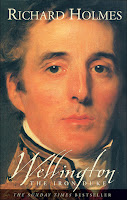
BOOK REVIEW: Wellington. The Iron Duke by Richard Holmes

I am squeezing in one more book review before the end of the year. One of my Christmas presents this year was the biography, Wellington: The Iron Duke by Richard Holmes. I wanted to balance the biography of Napoleon with one of Wellington. 


This book is only about 300 pages, as opposed to Napoleon: A Life, which was nearly 1000. So it is nowhere near as comprehensive, but as a trade-off is a much quicker read. Despite its brevity, it presented a detailed, balanced discussion of Wellington’s life with a concentration on the military history. It whet my appetite to learn more about the man, but not right away.

If you’re interested in a very good overview, one that gives a good sense of the man and his accomplishments (though less of a sense of the times), this biography is just right.

Tuesday, November 30, 2021

BOOK REVIEW: Napoleon: A Life by Andrew Roberts

 As part of my plan to increase my knowledge of the Regency Era, I thought I really needed a better handle on Napoleon. I knew the basics: French General, French Emperor, lover of Josephine, defeated at Waterloo. Also that he was not only a brilliant military commander but also an innovative administrator. But, overall, kind of a bad guy.


Wanting more detail, I plunged into what is called the definitive biography, Napoleon: A Life by Andrew Roberts. This is a superb biography. It did, unfortunately, take me a very long time to read and bogged down my reading progress in general. (I took a couple of breaks, but always felt guilty reading other things.)  I finally finished it today. I’m pleased to note that my basic knowledge was basically correct.

This is a comprehensive birth-to-death biography. The bulk of the detail is centered on his military career, which makes sense. However, for a reader like me who zones out when the battle tactics are described in depth and who skips over battlefield maps, it was more than I needed. It was fascinating in a big picture way, but the details will never stick with me.

More impressive to me was the way the book touched on the personality of the emperor, showing his hubris and his (possibly feigned at times) humility, his wit, his sang-froid, and his extraordinary charisma. His micro-managing attention to detail boggles the mind. His superhuman energy (especially in his younger days) is hard to fathom. And his intelligence, memory, and analytical skills are as impressive today as they were to his contemporaries. 

It’s impossible to come away from this biography unimpressed with Napoleon. At the same time, without the benefit of being exposed to his personal charm, it was impossible for me to come away from it favorably impressed in the balance. The wake of death and destruction his ambitious empire building left across Europe was enormous. And despite his protestations that everything he did, he did for France – he was clearly doing it for personal glory and profit. I found myself astonished by the magnitude of his victories, yet rooting against him the whole time.

Tuesday, October 26, 2021

BOOK REVIEW: The Library: A Fragile History by Andrew Pettegree and Arthur der Weduwen

 I received this book for free from Netgalley. That did not influence this review.


I love libraries. My favorites are large academic libraries with their stacks filled with obscure treasures. My local public library is next. In addition to the great selection in the citywide system, the librarians seem to be able to obtain just about anything I’m looking for. I even love the goofy libraries at vacation spots, more likely provided for show than because anyone is expected to read the odd old assortments. And then there are private libraries… I’ve always wanted a room with wall-to-wall, floor-to-ceiling bookshelves and a sliding ladder. I’ve settled for books all over my house.

When I saw The Library: A Fragile History by Andrew Pettegree and Arthur der Weduwen available on Netgalley, I knew I had to read it.

This new release is a comprehensive history of the library, from idea to execution, with all the myriad cycles of building and destruction (or fading away). It covers the “public” libraries of antiquity, the massive personal libraries of royalty and wealthy men, institutional libraries, subscription libraries, modern-day public libraries, pretty much every form of book collecting for personal use or for sharing. It covers the rise and fall of great libraries alongside the rise and fall of civilizations. It addresses the question of the future of the library. (Have faith! People have been predicting the end of “the book” for as long as there have been books. Libraries, too, will survive in one form or another.)

The Library is an impressive undertaking. It’s comprehensive (a bit lengthy) and detailed (so a bit dry), but my interest never flagged. The resiliency of the library as a concept and as a concrete public service is inspiring. Book lovers, readers and collectors, and all library nerds will find this an interesting and reassuring study of the topic. 

Thursday, September 30, 2021

BOOK REVIEW: The Regency Years: During Which Jane Austen Writes, Napoleon Fights, Byron Makes Love, and Britain Becomes Modern by Robert Morrison


I read a fair amount—all right, a lot—of Regency Romance. It’s pure escapism. But it doesn’t give me the same sense of immersion in place and time that general historical fiction does. Despite all the genre Romance I’ve read, I don’t have much actual knowledge of the Regency time period. So, I’ve embarked on a reading spree of British history. The books include The Age of Decadence by Simon Heffer and Victorious Century by David Cannadine. They were both informative in their own way, but lengthy and serious. I wanted something focusing more specifically on the Regency period that would give me more of the flavor of the times, more of the social history.

The Regency Years: During Which Jane Austen Writes, Napoleon Fights, Byron Makes Love, and Britain Becomes Modern by Robert Morrison was just the book I was looking for. Drawing heavily on the personalities of the time period, inserting anecdotes throughout, the book does a wonderful job of giving a broad view of the historical events and a close-up view of some of its notable personalities. Fact-filled yet very readable, I got this book from the library, but plan to buy a copy to keep on my shelf.

Monday, September 6, 2021

BOOK REVIEW: Gilded Age Cocktails: History, Lore, and Recipes from America’s Golden Age by Cecelia Tichi


After enjoying the book Jazz Age Cocktails: History, Lore, and Recipes from America’s Roaring Twenties by Cecelia Tichi, I decided to read her previous book, Gilded Age Cocktails: History, Lore, and Recipes from America’s Golden Age. Similarly, it’s a short history of the cocktail placed in the historical context of the late nineteenth century. Again, it touches upon a few of the historical events and well-known figures of the times, and gives cocktail recipes for what they imbibed and served (or might have imbibed or served). It’s a short, entertaining book. The cocktail recipes got a bit monotonous, seeming to be mostly slight variations on the same few ingredients. Nevertheless, it was interesting to see the oversized role played by cocktail drinking in the Gilded Age. Similarly, it’s a short history of the cocktail placed in the historical context of the late nineteenth century. Again, it touches upon a few of the historical events and well-known figures of the times, and gives cocktail recipes for what they imbibed and served (or might have imbibed or served). It’s a short, entertaining book. The cocktail recipes got a bit monotonous, seeming to be mostly slight variations on the same few ingredients. Nevertheless, it was interesting to see the oversized role played by cocktail drinking in the Gilded Age.