Monday, August 31, 2020

BOOK REVIEW: Short Years: The Life and Letters of John Bruce MacCallum M.D. by Archibald Malloch

 I just finished a beautiful old book, published in 1937, called Short Years: The Life and Letters of John Bruce MacCallum, M.D. by Archibald Malloch.
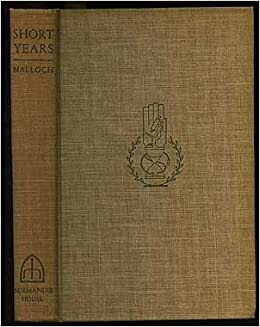

MacCallum was a turn-of-the-twentieth century, Canadian-born, Johns Hopkins-trained physician/scientist who devoted his short life to experimental medicine. He started out as a morphologist, most known for his work on heart muscle, and ended up an experimental physiologist. He was also a poet, an author of short stories, and a prodigious letter writer.

The book is primarily a chronological collection of edited letters. The author (Malloch) annotates them so that the story flows well but he very effectively keeps himself out of it as much as possible to let MacCallum be the one to breathe life into his own story. The writing is achingly beautiful, full of dreams, aspirations, love of research, love of friends, loneliness, and also humor, imagination, and optimism. I found myself reading passages out loud to my husband because they were just so striking. 

What gives this book particular depth and poignancy is that the young physician/scientist contracted tuberculosis while a medical student. Although in earlier letters the dreaded diagnosis is only hinted at, he worked in a place where the symptoms were very readily recognized, tuberculosis was rampant in American society, and his older brother was also a physician. John MacCallum undoubtedly knew his diagnosis and prognosis from the very first. 

He devoted himself to work, accomplishing an extraordinary amount in his short years, despite his physical limitations. He made friends wherever he went, and his death was hard felt by a large community of medical and non-medical people from Canada to Baltimore to Berkeley. 

He also had two romantic friendships with women with whom he corresponded for many years. It’s unclear how the relationships might have progressed had he been healthy, but it does seem that his illness put up a wall against marriage, even if he had been inclined to pursue it. The book has a very early-twentieth-century way of preserving the anonymity of these women, referring to one as “Miriam,” which was not her real name, and the other as “the poetess.” It’s frustrating not to be able to identify who they were and it seems time erased the trails. And yet, their identities don’t really matter.

One of the fascinating things about the book is how MacCallum will write to a friend, to his parents, to his mentor, and to his brother letters covering the same event, written within a couple of days, and put different spins on it for each audience. He might use the same turn of phrase a couple of times, but then elaborate on or play down his thoughts on what he’d done or what took place. It gives a more rounded picture of the man and really humanizes him.

I love epistolary novels, and this book reads like one. It makes me wish people still wrote like this. Instantaneous communication is wonderful, but what a loss for the literary world and for future historians to think that people’s voices won’t be preserved in this way for posterity.

Saturday, August 29, 2020

BOOK REVIEW: Destroying Angel by S.G. MacLean

 England in the mid 1600s, under Oliver Cromwell’s Protectorate, was a scary and oppressive place to be. I don’t know much about that time period, but S.G. MacLean’s historical thriller series featuring the captain of Cromwell’s Guard, Damien Seeker, is teaching me quite a bit.

Seeker is utterly loyal to Cromwell and works closely with the chief government spy, Thurloe. In the previous two books, starting with The Seeker, the reader is introduced to this strong, complex military man who is feared and hated by many on both sides for good reason. However, we also learn that he can be gentle and kind to those in need. And that he certainly does have a heart.

At the end of book two, Seeker is forced to walk away from the woman he has come to love because he can’t serve Cromwell and look away from her brother’s treasonous leanings. 


In book three, Destroying Angel, Seeker has been sent north to the Yorkshire moors to connect with the Major-General sent there to keep order and to look into the possible return of a banished Loyalist, Thomas Faithly. Faithly had been in exile with the young King, and it is supposed that he has returned to his ancestral estate to drum up support. This sort of thing, rooting out Royalists, is all in a day’s work for Seeker, but there are complications.

Seeker is originally from Yorkshire—not Faithly Moor, where he has been sent—but the area around it. And it was in Yorkshire, as a young man, where personal tragedy changed the course of his life. I don’t want to introduce spoilers for the first two books, but Seeker’s marriage was destroyed and he lost contact with his daughter. With nowhere else to turn, he fled to join Cromwell’s Army and the bitterness and cruelty of that life made him what he is today. He is very, very good at soldiering--cold, demanding, and relentless. (He’s also very good at solving political mysteries.) 

Now that he is back in his old stomping grounds, his past comes back to haunt him.

There is a lot going on in this book. Seeker not only has to search for Faithly, but he also becomes involved in solving a murder of a young girl, the ward of the town constable, a loyal Cromwell supporter. The town is also undergoing an upheaval because of the arrival of a “trier,” a rigid Puritan examiner who has been called in to try the local rector who has been accused of not being Puritan enough. Bitter, long-held grievances between villagers are at play, and Seeker has to sort through what is important and what is not. There is also fear of witchcraft and those who would hunt witches. Although at first it is a lot to take in and keep track of, the reader just needs to keep following the protagonist. Seeker is as clever as ever at untangling the threads until it all comes clear.

These are fascinating novels. Thrilling and disturbing. We keep rooting for Seeker even as the cause he serves becomes more and more corrupt. At some point, there will have to be a reckoning as Cromwell’s England becomes just as evil as the regime it replaced, moving farther from the ideals that drew Seeker to the fight. I’ve got the next book on hand and am anxious to see what comes next.

Sunday, August 23, 2020

BOOK REVIEW: The Crowded Hour: Theodore Roosevelt, The Rough Riders, and the Dawn of the American Century by Clay Risen

 Every once in a while I get an urge to pad some of the many gaps in my historical education. One of these gaps is the Spanish-American War. Buzz words I remember are “yellow journalism” and “Remember the Maine.” After reading the novel Hunting Teddy Roosevelt I wanted to learn more about Roosevelt and his Rough Riders. What was that all about?

The Crowded Hour: Theodore Roosevelt, The Rough Riders, and the Dawn of the American Century by Clay Risen, published last year to some critical acclaim, was just the book to bring me up to speed. Roosevelt is the star of the show, but this is more than just a time-limited biography of the man. It’s a more inclusive look at the factors leading to the war and an explanation of how Roosevelt played the out-sized role that he did. The account of the war itself is very detailed and other prominent Rough Riders are also featured. 

The book’s focus is narrow. It doesn’t delve into what else is going on in the U.S. or the world at the time, but it gives enough of an overview to provide context. It does exactly what it needs to do to explain the Spanish-American War to someone whose knowledge of it was far too superficial.

Thursday, August 20, 2020

BOOK REVIEW: The Disappearance of Winter's Daughter by Michael J. Sullivan

 I found a bright spot in the gloom. Michael J. Sullivan wrote a fourth book in the The Riyria Chronicles that I somehow missed: The Disappearance of Winter’s Daughter.

Many years ago, I discovered the superb high fantasy trilogy, The Riyria Revelations, starring the entertaining duo Royce Melborn (assassin) and Hadrian Blackwater (mercenary) who have teamed up as thieves for hire. The unstoppable pair save the world piece by piece, one adventure at a time. The books are fast-paced, excitement-packed, and delightfully funny. The wisecracking friendship between the two is what makes the books addictive. 

So, when I finished the trilogy, I was thrilled by the release of prequels, The Riyria Chronicles, which filled in the backstory of how the two met and began their journey together. After the third, The Death of Dulgath, it seemed the series went on hold and, though I mourned, I eventually moved on. 

Fortunately, I stumbled on this fourth book and quickly purchased it. Now I’m hooked all over again.

A wealthy whiskey baron from a city once terrorized by Royce (in his early life, when he went by the name “Duster”) hires him to find out what happened to his daughter, Genni, who married a duke from the city of Rochelle. She has disappeared and is believed dead. The grieving father suspects the duke wed her for her dowry then had her killed. If that’s the case, he wants revenge, bloody revenge. He knows “Duster” is capable of devastating a city; he’s done it before.

The pay is good. Royce is willing. Hadrian goes along, expecting, in his cheerfully optimistic way, to find the woman alive.

It should have been an easy job, but they enter a city full of nobility awaiting the appointment of a new king. The old king, along with his whole extended family, has supposedly drowned at sea in a storm. In such a situation, the bishop gets to appoint someone. He intends to appoint himself, but first he needs to get rid of his competition, which is all the nobility of the land, in one fell swoop. To accomplish this, he enlists help from a few of the downtrodden of the town, who possess some dangerous magic. Royce and Hadrian not only have to find the woman and rescue her, but they have to do it before the demons are unleashed. The race is on!

Once again, Sullivan provides a rollicking adventure. The trademark banter between the protagonists is there, but more muted than in some of the previous books. There is some interior monologue that gets a little too earnest as Royce seeks to understand the changes being wrought in his own psyche after so much exposure to Hadrian. It’s necessary character development, but steals a bit of the mystery of Royce.

This book was actually published back in 2017. I’m not sure how I missed it until now. The author has been working on a new series that takes place in the same universe but centuries (millennia?) before. I’ve read one of these, The Age of Myth. While it is great fantasy, it doesn’t have Royce and Hadrian and the humor is missing, so I haven’t followed the series. I’m just hoping Sullivan will find inspiration and time for a book five in the chronicles.

Monday, August 17, 2020

BOOK REVIEW: Hunting Teddy Roosevelt by James A. Ross

 I had the pleasure to read this newly released historical novel pre-publication. Highly recommended for historical fiction fans!

A thrilling blend of historical fact and fictional adventure, Hunting Teddy Roosevelt takes the reader on safari with ex-president Teddy Roosevelt as he pursues big game while contemplating an unprecedented third term. But his African exploits may well doom his political career. He encounters predators more ferocious than lions and rhinoceroses, including an assassin with a personal grudge hired by determined political foes. And when an old flame turned muckraking journalist joins the safari, Roosevelt faces a danger even more threatening to his political career: a ruined reputation. With beautifully written detail, author James Ross seamlessly chronicles the hunt, draws attention to the political conflicts and human atrocities of the time, and paints a lush picture of the African wilderness, while presenting Roosevelt as both larger than life and touchingly, vulnerably human.

Thursday, August 13, 2020

BOOK REVIEW: The Flaxborough Crab by Colin Watson

 Back in 2018, I discovered (thanks to Netgalley) the re-released Flaxborough Chronicles of Colin Watson. Starting with Coffin Scarcely Used, which I loved, I started reading my way through several of them. In general, I liked the earlier books better. I got them a bit out of order, and stopped with what I think was the last in the series, but missed some along the way. One of these, The Flaxborough Crab, has been on my kindle queue for quite a while, so I finally loaded it up to read.

This is book six in the series. Again, it pits Detective Purbright against the criminal element. Purbright is an intelligent, methodical, and generally unexcitable chief detective in a small English town that sees more than its fair share of crime. The book begins with an off-putting series of sex crimes, off-putting because of the response to them. Watson has an ironic style that doesn’t fit well with attempted rape and flashing. The police seem amused by the crimes and some even hint that some of the women took pride in the excitement of being harassed, commenting also on the relative attractiveness of the victims.

However, that aside, the plot (typically far-fetched in this satirical crime novel series) holds together. The author’s skill at humorous description remains the best part of the book. The story is sped along by the reappearance of Miss Teatime, a fiercely intelligent con artist who has the habit of becoming embroiled in the adventures and aiding Purbright, but whose motives are generally mercenary.

While my enthusiasm for the series has faded somewhat over the years, I still find that once I start one of the books, I can’t put it down. I’m carried along by the old-fashioned dry wit of the narrator. If you like old-style British humor, this series delivers.