Showing posts with label magical realism. Show all posts

Monday, August 3, 2026

Book Review: Before I Knew I Loved You by Toshikazu Kawaguchi

Before I Knew I Loved You by Toshikazu Kawaguchi is the sixth book in the author’s series of stories about a magical coffeehouse where a person might be given the chance to go back (or, rarely, forward) in time. The series begins with Before the Coffee Gets Cold, but the books can stand alone.

There are very specific rules to this time travel. The travelers must sit in a special seat in the café, and while in the past, they cannot leave the seat. The voyage begins with a sip of specially prepared coffee and, most critically, before the coffee gets cold, they must drink it all and return to the present. Or else, ominously, they will not be able to fully return to the present.

Other rules include the conditions that they can only meet up with a person who had been in the coffeehouse at that particular time. And they have to accept that the visit will not change anything in the present. So who makes these journeys? Generally, it is people with specific regrets involving a particular person.

In this collection, the travelers are: 1) a young woman who treated her stepmother cruelly and wants to apologize, 2) a man waiting for the return of a junior high crush who could have been a sweetheart, 3) a woman with a cancer diagnosis who wants to travel to the future–to see if she’s still alive, and 4) a 14-year-old boy struggling with his father’s sudden death, who wants to see him one more time.

The stories are all bittersweet. What stands out is the kindness and concern shown by each of the café workers, customers, and time travelers. In a time of incivility, the civility of the characters may be the most magical ingredient of all.

Wednesday, October 8, 2025

BOOK REVIEW: Indigo Field by Marjorie Hudson

Indigo Field by Marjorie Hudson is a grand, sprawling, multi-family, multi-generational epic set in contemporary rural North Carolina.

Rand Jefferson Lee is a retired army colonel who is embittered about life. He has moved to a retirement community at his wife’s request. She is active and sociable, while he simply wants to be left alone. His only real activities are running (to bring on a second heart attack) and dwelling on his plans to leave her a well–provided for widow. His plans fail when she is the one to die suddenly.

Joylene is a youngish widow with a late-teenage son with Down Syndrome. She owns a goat dairy farm and hard-scrabble garden. Actually, the bank owns it and she is desperate to hold onto it so she can continue to care for her son. But the mortgage needs to be paid and she just can’t keep up.

Reba is an elderly Black woman with native blood whose people at one time populated the whole area. She is the last of her line, after a meth-addled white man killed her niece. Now, she is fostering the killer’s troubled young teenage son because her niece loved the boy, and he has no one else. Reba also has second-sight and communes with spirits, adding a touch of magical realism.

Reba and Joylene are friends, even though Reba has had nothing but pain and suffering from the white people she encounters. This now includes Rand, who smacked into her old rusting car while he was running and looking at his phone. She feels he should pay to fix the dent. He feels she is at fault and is just after his money.

The characters all have deep, dark secrets. The book is permeated with grief and loss. It takes a cataclysmic storm to bring everything out into the open in this immersive, ultimately redemptive novel.

Monday, November 13, 2023

BOOK REVIEW: Let the Dead Bury the Dead by Allison Epstein

 I received this book for free from Netgalley. That did not influence this review.

Allison Epstein is now a must-read author for me. I loved her debut, A Tip for the Hangman, so I was eager to read her newest release, Let the Dead Bury the Dead.


Let the Dead Bury the Dead
is an alternate history, so although the characters are all fictional, the story is placed in a historical context (Russia, 1812, just after Napoleon has been chased away) where it feels as if the events could be real. (Except, for the vila, the witch…) Slavic folklore is woven into the tale adding magical realism to the mix. I am not, in general, a fan of magical realism. And I admit that the first time Sofia turned into an owl, I was a bit put off. And yet, the characters were so compelling, the writing so beautiful, and the folk tales so perfectly adapted to fit in with the story, that it all worked to create a novel I couldn’t put down.

In the aftermath of Napoleon’s defeat in Russia, the tsar wants to consolidate his power at home. If this means crushing the life out of his own people, the very people who supported his army and country, giving their all, so be it. The tsar and his family live in obscene luxury while the common people, pretty much everyone else, starve. The tsar’s second son, Felix, the Grand Duke, dared once to speak up for the people and found himself banished to a palace 15 miles from St. Petersburg where he has given himself over to idle hedonism.

Felix’s lover, the soldier Sasha, has now returned from the war. On his way to find Felix, he comes across a woman of unearthly beauty (Sofia) nearly dead from the cold, lying in the forest. He rescues her. This is something he quickly comes to regret. Sasha comes from the poor peasantry and was raised on the old stories. He recognizes a witch when he sees one.

Sofia plays on Felix’s ambition to convince him he is the leader the people need, setting things in motion and tearing the two lovers apart. 

At the same time, Marya, a young woman involved with a group of revolutionaries and the right hand of the group’s leader, Isaak, is busily helping to organize a general strike. It’s exceptionally dangerous as the tsar will certainly crack down at the merest hint of dissent. Nevertheless, Marya has faith that good can come out of a popular revolt. It’s necessary. Sofia works her magic on Marya also, convincing her that she has more to offer than simply following Isaak’s lead.

The novel works so well because of its moral ambiguity. Each of the main characters is partly right and very much wrong. The world is overwhelmingly against them and no simple solutions are available. Good can’t conquer evil when there is no pure good and no pure evil. (Although Sofia certainly comes close to pure evil, even she makes some good points. The tsar is evil, but evil in the commonplace cruel dictator way, and eliminating him will solve nothing.)

If you want to lose yourself in a beautiful historical fairy tale, I can’t recommend Let the Dead Bury the Dead highly enough.

Thursday, September 8, 2022

BOOK REVIEW: The Many Daughters of Afong Moy by Jamie Ford

I received this book for free from Netgalley. That did not influence this review.

Jamie Ford, author of Hotel on the Corner of Bitter and Sweet, has a new book out: The Many Daughters of Afong Moy. The novel combines historical/contemporary/futuristic fiction and magical realism in a multi-generational exploration of inherited trauma/epigenetics.


Although there are several women portrayed in the novel, two are the bookends to the storyline. The first is Afong Moy (based on a true historical figure.) She is the first Chinese woman to come to the U.S. – against her will. She was treated as a type of circus freak, with audiences particularly agog because of her tiny bound feet. She was essentially enslaved and forced to perform. Her story ends in tragedy. Her memories become embedded in the psyches of her descendants.

Each of these descendants has an interesting story of her own. Each lives their own particular tragedy. The stories are beautiful and a bit painful to read.

The traumatic memories are not only inherited but are cumulative. By the time we reach Dorothy Moy’s story, it is the year 2045. Dorothy lives in Seattle, a city rattled by climate change. She is a renowned poet, or was, until she was forced to resign because of her dissociative disorder. She’s in a bad relationship, unemployed, and, worst of all, she fears her five-year-old daughter is sliding down the same path. She’s ready for something drastic. Her therapist recommends an experimental treatment, a genetic therapy that will help her ferret out the inherited memories embedded in her brain. (There is actually scientific research being done in this area.)

Dorothy has to get worse before she gets better. She experiences things that are shown happening in the lives of her ancestors in other chapters. The intertwining of the stories is deftly done.

There is also a man, the soul-mate of Afong Moy, who weaves in and out of all the women’s lives, trying to reconnect, but always just missing. 

There is a lot going on in the novel and it would probably bear reading twice to fully appreciate all the nuance. But even if you can’t read it twice, it’s well worth reading once!

Monday, March 7, 2022

BOOK REVIEW: The Illness Lesson by Clare Beams

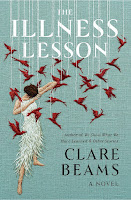
The Illness Lesson by Clare Beams is a complicated book, difficult to read and difficult to review. It is certainly beautifully written and psychologically complex. The plot begins slow; it is thought-provoking and melancholy. Symbolic bird imagery lends a touch of magical realism that eases the reader into the unexplainable events that begin to occur, events that suddenly catapult the plot down horrifying, stomach-turning lines that will make you want to rage, or weep, or both. And yet.


And yet there was something unsatisfying in the way it played into stereotypes while calling them out. The bird imagery took off but landed flat. (Fans of magical realism may disagree.) The clearest truth to emerge was the utter lack of accountability of evil-doers. The protagonist saved the innocent…maybe. Or maybe it was too little too late. She saved herself by skirting the issue and removing herself from the situation, which was, admittedly, the only thing she could do. I can’t blame her for her lack of courage. She didn’t really have a workable option; at least she did what she did, and maybe that was the point.

The Illness Lesson, despite being fictional and containing a dose of magic, highlights a very real, oppressive abuse that not only took place in the past, but goes on in the present day, in guises that are only minimally different. The novel illustrates a lesson that hasn’t been learned.

Tuesday, July 20, 2021

BOOK REVIEW: All's Well by Mona Awad

 I received this book for free from Netgalley. That did not influence this review.

Magical realism is my least favorite genre. However, I’m occasionally intrigued enough by a blurb for a story to give one of these novels a try. All’s Well by Mona Awad had an interesting premise, so I requested it. I found it impossible to put down.


Miranda Fitch is the unfortunate protagonist. A young woman, once an up-and-coming stage actress, Miranda suffered a fall during a performance of Macbeth which has left her with severe, debilitating, chronic pain. She has tried everything: surgery, physical therapy, acupuncture, massage, psychiatry, and large doses of pain killers and muscle relaxants. Nothing helps. Suffering destroyed her career and her marriage. It has aged her beyond her years.

When it first became apparent that Miranda could not return to the stage, her husband urged her to apply for a teaching job in a small theater program at a local college. She was hired and has, for a few years, directed the annual student Shakespeare play. This year, she intends to direct All’s Well That Ends Well, a play she once starred in and remains obsessed with. However, the students, particularly the spoiled and minimally talented female leader of the theater group, Briana, want to put on Macbeth. Since Briana’s parents are the main financial supporters of the college’s theater program, Miranda finds herself backed into a corner by the administration.

So far, the novel hasn’t strayed from contemporary realistic fiction. It presents a horrifying picture of chronic pain syndromes. In particular, it demonstrates how chronic pain is poorly understood and how female pain, in particular, is perceived as not quite real. Because the myriad physicians and therapists Miranda sees are unable to find an anatomic reason for her pain, they are dismissive of it. Or are they? They continue to treat her to the best of their ability. However, they grow impatient with her and frustrated by her. Maybe they do believe her, but they can’t help her.

It’s not surprising that Miranda is unpleasant to be around. It’s understandable that she is so miserable that she spreads misery. I wanted to mentally distance myself from her, so I can imagine how her fictional friends, colleagues, and students wanted to avoid her. I found myself growing anxious, knowing that accidents happen and chronic pain can strike anyone. Yikes! Awad does a wonderful job of showing Miranda suffering the throes of pain and loneliness.

Then, things get weird. She meets three strange men, witches of a sort, in a bar. They seem, somehow, to know all about her. They offer her a drink, an elixir, that puts her into a dreamlike state, and they explain that pain can move. From person to person. Miranda discovers she can alleviate her pain by transferring it to others. And, naturally, there are people whom Miranda would like to see suffer.

Miranda is transformed from a suffering, somewhat unpleasant, but generally good person, to a giddy-with-health, sexy, playful, absolutely horrible person.

The magical, otherworldly part of this novel fits right in with its Shakespearean themes. Even though it’s weird, I was drawn into the weirdness. Miranda is such a believable character, that even when the world around her spirals out of control, even when she seems lost in other-worldliness, the story remains grounded in her struggle against what pain had done to her. Even though it’s in the magical realism genre, I was wowed by this thought-provoking book.