Showing posts with label science. Show all posts

Thursday, September 13, 2018

BOOK REVIEW: We by Yevgeny Zamyatin

We by Yevgeny Zamyatin is a classic dystopian novel written in 1920-21 that was translated and published worldwide at the time, but banned in Russia until 1988. It was the inspiration for George Orwell’s 1984.

The novel is set in a future world on earth, after a 200-year war that changed society completely. People now live in a world made of nearly indestructible glass, their lives on public display. (They are under surveillance by "guardians.") They live according to rigid schedules, everyone rising, working, eating, taking a walk in the square at the same time, even chewing according to regulation. Sex is permitted only when a person receives a pink ticket to "lower the blinds" of their apartment for an hour. The partner is assigned. People are not named, but numbered. Nonconformity is swiftly, and publicly, punished by death.

The protagonist, D-503, is a mathematician, one of the chief builders of Integral, a spaceship designed to spread their ideal society to other planets. He is fully indoctrinated into this totalitarian society, ruled by the Benefactor. He believes himself completely happy.

And then I-330 enters his life. She makes him very uncomfortable. He dislikes her at first, but is sexually attracted to her and she exploits this, leading him to break rules and become reluctantly complicit in hiding her noncomformity. I-330 is one of the leaders of the resistance. Their goal is to hijack Integral and use it to smash the barriers of their glass world. They want to start a revolution that will return freedom to the people.

There is nothing heroic about D-503. He wants to remain in his bubble. But he also wants I-330. He discovers, to his dismay, that he has a soul and imagination. With all these upheavals, his life is a torment.

The resistance permeates society to a greater degree than D-503 realizes. But the state is strong and has a new weapon – an operation that can remove human imagination. Which will prove stronger?

The stark philosophies of the characters provide interesting food for thought. D-503's fear of freedom and his contrasting comfort with the highly intrusive state are chilling. The novel does come across as somewhat dated, since dystopias are now so numerous with much more explicit sex and violence and more in-depth characterizations. D-503 thinks mathematically and is confused much of the time, which makes it a tough read. Nevertheless, it’s fascinating to see how many of the issues are still relevant and likely always will be.

Sunday, September 17, 2017

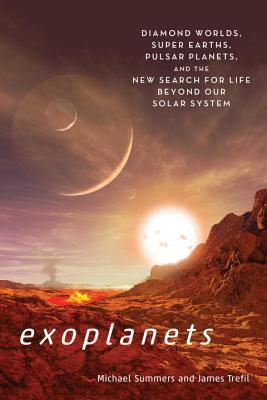
BOOK REVIEW: exoplanets by Michael Summers and James Trefil

Time for some nonfiction. My son, in college, wants to eventually study exoplanets, so when I saw this book in the library, I thought: why not?

Exoplanets are planets outside our solar system. Apparently, in the last few years, astronomers and physicists have been discovering new planets at a blistering pace. It isn’t surprising that there are scads of these planets or that their diversity is staggering. What I found more surprising was that the first one was discovered in 1992–which is really just yesterday. I feel like I’ve known all my life that out there in the vast infinity of space there are gazillions of planets. (We watched Star Trek, after all.) But what we all knew wasn’t proven with what was "seen" (in the weird mathematical way that physicists see things) until the first exoplanetary system was discovered in 1992.

exoplanets by Michael Summers and James Trefil is a readable, fairly simple overview of the exploding field of exoplanet research. It explains how recent advances have made study of deep space more feasible, leading to the necessary abandonment of previous "chauvinisms" or at least acceptance of new paradigms. Again, for someone whose view of planetary science was shaped by science fiction, none of these new discoveries seem so revolutionary. But maybe the realization that Diamond Worlds, Ice Worlds, Rogue Planets, and even, possibly, non-carbon-based life forms, are not fiction is what make this such a fascinating field of study.