Showing posts with label classics. Show all posts

Friday, October 31, 2025

BOOK REVIEW: The Good Earth by Pearl S. Buck

I was ready to read a classic, so turned to The Good Earth by Pearl S. Buck. I read it way, way back in middle school, but remembered nothing about it except that it was set in China. I wish I could remember what middle-school me thought about it, because I’m sure I couldn’t have understood the half of it.

Written in the early 1930s, it portrays rural Chinese peasant life through the eyes of Wang Lung. He starts out as a dutiful son, a farmer on his wedding day, going to the house of the local lord to obtain the slave, O-lan, that his father had purchased for him to marry. Much is made of the fact that she is not physically attractive and rarely speaks. But fortunately for Wang Lung, she is an incredibly hard worker and also fertile, giving him two sons in fairly rapid succession, with more children to follow.

The family endures hardship and famine. At one point, on the edge of starvation, they must flee south to the big city, where O-lan and the children beg and Wang Lung works menial tasks, until there is a local revolt. The house of the rich family there is invaded and looted. Wang Lung takes the owner’s money and O-lan finds a stash of jewels. With this, they are able to return to their home and buy more land. Wang Lung works hard, but it is really O-lan who makes it possible for them to survive. She is the brains in the family.

It turns out the only thing worse that grinding poverty is wealth and status. Wang Lung may be one of the most unpleasant protagonists I’ve come across in a long time. As his wealth increases, he feels embarrassed to be a farmer and hires laborers to work the land for him. Even though he misses it, and still understands the value of owning land, he believes he’s above working it. Worse, he never gives O-lan much thought or credit, seeing her always as little more than his slave. While this is likely historically and culturally accurate, it’s still heart-breaking. Or maybe infuriating.

As soon as he has the money, he heads off to a brothel, falls in love with a prostitute, buys her, and installs her in his house (after building her a second wing, decorating it lavishly, and providing her with a servant – all while his wife continues slaving away for the rest of the family.) For good measure, he insults O-lan, telling her he couldn’t possibly love her because she’s so ugly.

Eventually, O-lan dies. Wang Lung feels some momentary regret, but forgets about her quickly enough. He always manages to push away his better feelings with anger and a sense of entitlement. As soon as his wealth is great enough, and his grown-up sons are haughty enough, they move away from the farm into the now deserted house of the old local lord. Wang Lung essentially takes over as the new local lord. He and his family grow as decadent as the old lord. Until, as an old man, he moves back to his farmhouse to prepare to die.

But is it a good book? It’s a fantastic book. The writing is spare but beautiful. Although Wang Lung is the only viewpoint character, we can nevertheless peer into the hearts of each of the main characters. The depiction of the culture is fascinating. The book won a Pulitzer Prize and Pearl S. Buck won a Nobel Prize. So I am glad I read it, infuriating as it was.

Monday, August 25, 2025

BOOK REVIEW: Purely Academic by Stringfellow Barr

If you enjoy satirical novels about the world of academia, you won’t go wrong with Purely Academic by Stringfellow Barr. (How’s that for an author name?) Although first published in 1958, it feels surprisingly contemporary. The more things change, the more they stay the same.

The novel largely focuses on Dr. Schneider, chairman of the history department, but other characters also share their views: the pompous but effective university president who’s seeking a bigger, better job; the chairman of the economics department, a schmoozer who vacuums up all the funding for his own department and who wants to succeed the president; the schmoozer’s very young, beautiful, charming wife who is bored with their marriage; the president’s Machiavellian secretary, the power behind the throne; a high-living member of a large philanthropic board, who may be the most clear-sighted of all, and others.

Although the jockeying for power, the politicking, the complaints about low salaries and unteachable students are timeless, the novel is written in an older style. It starts fairly slow as Barr maneuvers all the characters into place for the finale. He also head-hops, making the prose a bit clunky. But once you settle into the read, the style becomes less noticeable. What stands out is the irony. This novel is clever.

The characters are all unpleasant in their own way. Even Schneider, who you can’t help but root for, has some fairly large character flaws. And yet, I was entranced. Once the stage is set, the president gets the call to move up to a large state school. Then things start happening fast. 

Stringfellow Barr was a history teacher himself, who moved on to administration as a college president, and then to president of a research foundation. So it seems this book is written from the voice of experience. 

This is another old novel found in the library, but it’s available on kindle or used copies can also be found. If you’d like to see the academic world lampooned, give it a try. 

Monday, July 21, 2025

BOOK REVIEW: The Bridge of San Luis Rey by Thornton Wilder

It was time to read another classic, so I picked the Pulitzer Prize winner, The Bridge of San Luis Rey by Thornton Wilder, first published in 1927.

The blurb on my 2004 copy, taken from the foreword, calls it “As close to perfect a moral fable as we are ever likely to get in American literarure.”

So, what is it about? It’s about the 5 victims of a (fictional) bridge collapse in Peru in 1714. The rope bridge had been there for so long it was considered indestructible. So when it broke, there were those who considered it an Act of God. The collapse was witnessed by the local Franciscan, Brother Juniper, who decided it would be a perfect test for his theory that with careful study, one could interpret God’s plan. There is no such thing as an accident. There was a reason that these five people had been on the bridge that day. These five and no others.

Brother Juniper then spends six years compiling the information in the next few chapters, the life stories of the victims. The writing is beautiful. Their stories are moving and sad. Brother Juniper’s ultimate fate is surprising. And the conclusion seems to be the opposite of what he’d hoped to prove. In the end, it is the Abbess in the town who draws her own conclusion: the only thing that lasts, that has any meaning, is love.

It’s a short book, but not a quick read. Recommended for when you’re in the mood for something reflective.

Thursday, May 22, 2025

BOOK REVIEW: This Side of Paradise by F. Scott Fitzgerald

Many years ago, I bought a set of four F. Scott Fitzgerald novels, and they sat for a long time on my bookshelf. I eventually re-read The Great Gatsby, which I’d first read in school. In 2016, I decided to read Tender is the Night, which I enjoyed more than Gatsby. But it took me nine more years to pull This Side of Paradise from the shelf.

This is Fitzgerald’s first novel and definitely not his best. There is beautiful language, of course. And he plays around with structure, dividing the protagonist’s life into parts, subdivided into chapters, and then into scenes reading like anecdotes. One of these scenes is even written like a movie script. It’s interesting, but makes the read choppy.

It’s said to be semi-autobiographical. The protagonist is Amory Blaine, an upper middle-class boy growing up in pre-WWI America. He attends private school in the east and adapts to its demands. He’s intelligent, but not as intelligent as he thinks he is. He decides he wants to go to Princeton, and he does.

At Princeton, he looks around at who are the most socially successful of his classmates and imitates them. After a rocky start, his popularity rises, until he fails a math exam and has to resign from the Princetonian, a position that had given him credibility. Then he starts moving with a different crowd, and forms a couple of friendships that more or less last through the rest of the book. His best friend is a poet, and Amory also has a literary side. The book is sprinkled with poetry written by various characters.

There is a very brief interlude where he goes off to war. 

He has a series of love affairs, none of which last, for various reasons. His parents die. A priest that he was very friendly with and considered something of a mentor died. He doesn’t work– he lives off the income from his parents’ investments. And then they fail and he goes broke.

Throughout, he’s egotistical and unlikeable. I read the book with as much emotional investment as the summary I’ve given. I’m glad I read it, since it’s been gathering dust on my shelf. But at the end of the novel, I was left feeling who cares?

It reminded me a little of Catcher in the Rye and a little of Maurice. If you want to read an angsty male coming-of-age story, I’d recommend Maurice. If you want to read a Fitzgerald novel besides Gatsby, I recommend Tender is the Night.

Tuesday, February 25, 2025

BOOK REVIEW: A Portrait of the Artist as a Young Man by James Joyce

I thought I had read A Portrait of the Artist as a Young Man by James Joyce in a college English class, but I clearly had not. I just finished reading it for the first time.


A summary is deceptively simple. Joyce presents a fictionalized account of his youth and coming of age, from babyhood to young adulthood, through the eyes and thoughts of the protagonist, Stephen Dedalus. Dedalus struggles with issues of family, of Irish identity and politics, of Catholicism and faith, and of his increasing understanding of his own artistic, literary temperament. He learns he must break free of it all and strike out on his own.

Of course, this superficial summary doesn’t do justice to the book. It’s not easy to read, but it is extraordinarily rewarding. Joyce’s writing has to be experienced. Maybe I’ll try tackling Dubliners

Friday, January 24, 2025

BOOK REVIEW: Maurice by E.M. Forster

I read Howards End by E. M. Forster many years ago, and always planned to read more of his work. Finally, finally, I took out Maurice from the library. This is a quietly moving, beautiful, psychological novel that completely drew me in.

Maurice Hall is, in all outward respects, a “normal” character, almost too simple a protagonist for fiction. He goes to a local boys’ school, graduates to Cambridge University, and finally, as a young man, takes over his deceased father’s place in business. To others, he seems a regular fellow, a middle class snob, self-absorbed and disinterested in the things that consume most of his peers: work, politics, religion, gossip. But it is what is going on internally that makes him a richly portrayed, unforgettable protagonist.

Maurice is gay. In his young life, he is simply confused. At Cambridge, he’s even more confused, often angry, and sometimes has bright flashes of joy. He meets a fellow Cambridge student, Clive Durham, who is a step above him on the social scale. They have some deep conversations of the college-kid type. And they fall in love. It is a romantic but platonic love, although Maurice yearns for more.

They experience a few years of joyful, extreme friendship, until abruptly, Clive falls out of love. Maurice has to work through grief and come to grips with the fact that he is a lover of men and can’t change that about himself. In Edwardian England, this is regarded as perverse and criminal, and makes navigating the social world a sometimes dangerous challenge.

I don’t want to give away any more of the plot, because while the beauty of this novel is in Forster’s exquisite prose, Maurice’s journey is what makes it so compelling. Highly recommended.


Monday, October 14, 2024

BOOK REVIEW: The Beautiful and the Damned by F. Scott Fitzgerald

I felt the urge to read a classic, and chose F. Scott Fitzgerald’s The Beautiful and the Damned. What a gorgeous and depressing book.

Of course, the prose is lush. Oddly, the normal narrative is interrupted from time to time by scenes written as though for a screenplay. And that works, because the characters are acting their way through life. They are the shallowest protagonists to ever compel me to read over 120,000 words spanning just under a decade of their lives. They are not likeable. They aren’t even pitiable. And yet, I couldn’t walk away from the train wreck of their lives.

Anthony Patch is a young man, recently graduated from Yale, with no ambition and no direction. He inherited from his mother enough money to live on, just enough to maintain an indolent lifestyle. When he falls into debt, he sells off his principal, without much awareness of the fact that his income is thus going to fall. He isn’t much concerned, at any rate, because he has a fabulously wealthy grandfather and considers himself the man’s only heir. Never mind that he can scarcely bear the old man’s company. Grandfather Patch made his fortune in the usual unscrupulous ways, then settled into a life of pious judgmentalism. The grandfather doesn’t like Anthony any more than Anthony likes him. The rare times Anthony visits his sole remaining relative, he is always asked what his plans are. When is he going to work?

Anthony drifts along in his semi-sleepwalking state, accompanied by his best friend Maury, who also doesn’t have to earn a living. They drink a lot and have conversations that are as witty and deep as any drunk college kids. They have a third friend, Dick, who wants to be a writer. They are scornful of Dick, who talks of nothing but his work-in-progress, both because of his specific ambition, writing a novel, but also for having any ambition at all.

And then along comes Dick’s cousin, Gloria Gilbert. She is beautiful. She’s also self-centered, selfish, and a siren. Every man she meets falls for her. Her beauty and her charisma stem from her youth and her indifference. She needs to be the center of attention, and she is.

Anthony falls hard for her. And then, she falls hard for Anthony. They then proceed to bring out the worst in each other. Partying hard. Drinking far too much. Living beyond their means. Growing bored with one another. Waiting for Anthony’s grandfather to die.

The timeline carries them through WWI, which almost touches them, but not quite. Their ultimate downfall is always on the horizon, but the pace of their deterioration picks up as Anthony descends farther and farther into alcoholism. It’s brutal.

The novel is not as tightly plotted as The Great Gatsby. And it is far less emotionally compelling than Tender is the Night, my favorite Fitzgerald work thus far. But after reading it, I’m more determined to work my way through all of Fitzgerald’s novels.

Monday, August 19, 2024

BOOK REVIEW: Crime and Punishment by Fyodor Dostoevsky

I just finished reading Crime and Punishment by Fyodor Dostoevsky for a class. I’m glad it was assigned or I likely never would have read it. Long, heavy, Russian literature in translation intimidates me. But this is a remarkably readable book, despite its length and depressing themes. 


Crime and Punishment
is one of those classics where it is obvious why it is a classic. Even in translation, it is beautifully written, thematically complex, and surprisingly gripping. I was surprised to find it gripping because much of the book comprises interior and somewhat repetitive suffering. But the character’s suffering is distant from the reader. We can understand it without feeling it ourselves.

Raskolnikov, the main protagonist, commits a premeditated murder, compounded by an impulsive one. He was obsessed with the act before committing it, and he wallows in guilt and attempted self-justification afterward. He is surrounded by people who love him or don’t, who suspect him of the crime or don’t, and he scorns them all and tries to drive them away. He also seeks them out. He’s terrified of being caught, but also ruminates over turning himself in. He has grand theories, and delusions of grandeur. Is he insane? Or is that just an easy explanation for modern readers?

The author dives deeply into the viewpoints of several characters, not just Raskolnikov. Their motivations are as clear to the reader as they are to the characters themselves, which often means they are obscure. It’s a book to linger over, and to read more than once. It helped to read it in a class!

Wednesday, May 31, 2023

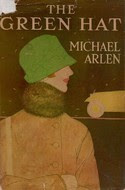
BOOK REVIEW: The Green Hat by Michael Arlen

I love old books. For one thing, if they have to be retrieved from the remote shelving of the local library and the pages are yellowed, you know they were not created by AI. The old-fashioned writing style can be both challenging and charming. In the case of The Green Hat by Michael Arlen, when the author is determined to make a point or elaborate on a theme, he goes off on verbose tangents. But there are gems hidden in the prose, sometimes insightful and sometimes clever and amusing, that make all the verbosity worthwhile. The many references that I don’t get make me all the more pleased when I do recognize something historical or obscure. And the stories draw me in by virtue of their strangeness.

The Green Hat was a popular novel back in 1924. I had never heard of it or of the author until I saw it referenced in The Prodigal Women by Nancy Hale. Intrigued, I wanted to read it.


The novel starts slow, primarily because of those verbose tangents. The author is making a point about England – the old aristocratic England that was fading away post WWI. It’s a novel ostensibly about a woman, an idealized woman, but actually the focus is more on the men in her sphere. Her name is Iris Storm, maiden name March. The old aristocrats care about her. They adored her as a child. But they are ashamed of the woman she has become. (She sleeps around.) She has been twice widowed. Her first husband, a favored, honorable young man of their circle, committed suicide on their wedding night. Her fault, she admits.

The narrator is another aristocratic young man, a friend of Gerald March, Iris’ alcoholic twin brother. He first meets Iris when she comes to visit her brother after an absence of ten years. The narrator is smitten with her, but in a detached sort of way. He is almost accidentally present at key points in her tale, but remains on the fringes of her drama. From this vantage point, he tells her story as it was revealed to him in little bits over the next couple of years.

The reader is sucked in as the narrator reveals what he learns, little by little. Always, the reader is aware there is more going on than meets the eye. The men are supercilious and a bit ridiculous as they adhere to their old beliefs and ideas of correct conduct. Iris stands outside of their rules. She goes her own way. And that means they have to shun her, even as they keep tabs on her. But she is as trapped by her own moral code as they are by theirs. And I get the sense that this is all an elaborate metaphor for post-war England.

The big reveal at the end is a nice twist, although it’s hardly the moral shocker to twenty-first century readers that it might have been at the time. If you can find a copy of this novel, give it a try. It’s quite fascinating.

Monday, May 1, 2023

BOOK REVIEW: Big Two-Hearted River by Ernest Hemingway

I received this book for free from Netgalley. That did not influence this review.

Big Two-Hearted River is a novella by Ernest Hemingway, being re-released in an illustrated Centennial Edition. This is one of the Nick Adams stories and it has the typical Heminway-esque voice and style.


Nick arrives by train to the burned-out town of Seney, a place near the Big Two-Hearted River where he has fly-fished before and intends to fish again. He is alone. The destroyed town is deserted. Nick strikes out on foot for the river. When he finds a good spot, he sets up camp. In the morning, he rises early and goes fishing. The End.

The setting is given in minute, attentive, loving detail. The particulars of the camp are meticulous. And the descriptions of fishing are so step-by-step that they could be a how-to manual. Throughout, the reader can feel Nick’s quiet satisfaction in an activity done well. 

If you’re a fan of Hemingway, this classic short work will be deeply satisfying. If you’ve never read his work and are curious about it, this is a fine introduction. One of the best things about this particular edition is the insightful foreword by John N. Maclean, who gives a strong, straightforward analysis of what Hemingway likely intended the story to illustrate, which gives the novella added punch.


Thursday, July 28, 2022

BOOK REVIEW: The Price of Salt by Patricia Highsmith

I’ve seen Patricia Highsmith’s 1952 classic The Price of Salt recommended a bunch of times as an example of early lesbian literature in the U.S. and one of the first with an ending that doesn’t leave at least one of the women dead or gone back to a man. Does this mean a HEA?

Not exactly.


The protagonist is Therese Belivet, a twenty-one-year-old woman just beginning in her career as a stage designer. She’s dating Richard, a wannabe painter, and she’s working part-time, through Christmas, at a department store in N.Y.C.. For backstory, she grew up in an orphanage after her father’s death and mother’s abandonment. So she has some baggage. However, her inability to love Richard and her distaste for sex with him is not the result of childhood trauma.

One day, a woman comes into the store looking for a doll for her daughter and Therese’s heart stops. It’s love at first sight. The woman, Carol Aird, leaves her address to have the doll shipped, and Therese boldly sends her a Christmas card. Carol responds with a lunch invitation.

Therese soon learns that Carol is in the process of divorcing her husband. The husband is trying to wrangle additional custody of their daughter, Rindy. This all makes Carol a bit moody and sometimes mean. In a way, Carol is trying to protect Therese. She knows better the consequences of two women falling in love.

Therese is too smitten to be put off by Carol’s shifting moods and they begin spending more time together. This culminates in a cross-country road trip. While on the road, their relationship develops further, both emotionally and sexually. So far so good.

However, they learn that Carol’s husband is having them followed by a detective, who now has evidence of their love affair. Seeing as this is the 1940s or 50s, running off with another woman is far more detrimental to Carol’s reputation than running off with a man. Her husband threatens to use the information to gain total custody of Rindy. And unless Carol gives up Therese altogether, he will not allow her to see her child again.

The novel has a very brooding atmosphere despite moments of joy. Conversations are often stilted. Interactions with other characters are often referred to after the fact, which keeps the focus on the pair but also adds to a sense of claustrophobia.

It’s easy to see why this novel is a classic. Still, I found the happy ending rather sad.

Wednesday, April 13, 2022

BOOK REVIEW: Pandora's Jar: Women in the Greek Myths by Natalie Haynes

 I received this book for free from Netgalley. That did not influence this review.

I loved Natalie Haynes’ novel of the women (and goddesses) of the Trojan War, A Thousand Ships. So when I saw she’d written a nonfiction exploration of a similar topic, Pandora’s Jar: Women in the Greek Myths, I wanted to read it as well.


Haynes is an authority on Greek myths, particularly the women in the tales. This new work looks at Pandora, Jocasta, Helen, Medusa, the Amazons, Clytemnestra, Eurydice, Phaedra, Medea, and Penelope and how they have been viewed through the ages. The earliest appearances of these women (whether human, goddess, monster, or some combination) are often quite different from the versions we have come to know through later--even modern--representations. I was a bit surprised to learn that the early Greek renderings were often less misogynistic than more recent versions. The variations in the stories are fascinating and the reasoning behind the changes are complex. Haynes traces the evolution of the various tales and offers insight into how we’ve come to settle on particular versions, as well as why the stories are destined to continually change.

Haynes has a great deal of empathy for the characters. She writes clearly, with great understanding and with wit. I have always enjoyed retellings of the old myths and I equally enjoyed this analysis. 

I recommend reading Pandora’s Jar and A Thousand Ships in tandem.

Monday, April 11, 2022

BOOK REVIEW: Goodbye, Mr. Chips by James Hilton

I have no idea when I first heard a reference to Goodbye, Mr. Chips. It seems I’ve always been aware of its existence, embedded in the culture, probably from the movie title. Yet I never actually saw the movie or read the book. What is it about? A teacher of some sort? So when I heard it referenced recently, out of the blue, I decided it was time to read the book. To my pleasant surprise, Goodbye, Mr. Chips by James Hilton is a novella that I could read in a sitting.

First published in 1933, the novel peeks in at the elderly Mr. Chipping, known to everyone as Mr. Chips, a retired school teached/headmaster, who devoted his life to a private boys’ school called Brookfield. This is described as no Harrow, but still one of the top second-tier schools in England. Mr. Chips is quite elderly as the book opens. He looks back at his life over the course of a few short chapters.

Mr. Chips’ career spans a busy time in the history of Britain and in the world. He started teaching at Brookfield in 1870 and continued on through the turn of the century, retired just before WWI and came back to help out “for the duration.”


Allusions to the war are made throughout, mainly as poignant mentions of alumni who were lost. One chapter shows Mr. Chips keeping his classroom together and teaching throughout a bombing, courageously helping the boys through the terrifying event. The war is central to the novel, as it was to the man’s life; and yet, the focus is so squarely set on Chips’ involvement with the school that the war is kind of hazily distant, a memory.The novel is mainly about this good man, his love for the school–which to him embodies the ideals of the Englishman, and his love for his country. He is helping to bring up the next generations of Englishmen. Times change, but he remains the same, mostly. Longevity helps him become an institution at the school and he takes pride and comfort in that.

He is an old-school gentleman and the later generations peg him as an old bachelor. However, embedded within the novella is a poignant love story. In middle life, he met, fell in love with, and married a younger woman whose more modern ideas challenged him and whose charm softened him. She died tragically. And he forged on.

The novella packs a lot into its few pages. The storytelling is simple and is mainly presented as narrative with a few short scenes. The secondary characters are sketched in. Even his wife is only fleetingly presented. And yet, there is emotional depth to the story because Mr. Chips is so fully fleshed out.

This is a charming story. And now I’ve finally read it!

Thursday, March 10, 2022

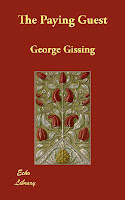
BOOK REVIEW: The Paying Guest by George Gissing

After stumbling across references to George Gissing, a masterful late nineteenth century novelist, and then reading the superb book New Grub Street, I was intrigued to find one of his novellas, The Paying Guest, in our library’s online catalogue. It was initially published in 1895. My library’s copy is a reprint from 1968.

The book can be read in one sitting. It’s written in that wonderful, straightforward nineteenth century style. The principal characters are the Mumfords and Miss Louise Derrick.


The Mumfords are a respectable middle-class London couple who have taken a house in the suburbs for the health of Mrs. Mumford and their two-year-old son. They have a quiet, affectionate marriage. They are not financially constrained, but Mr. Mumford isn’t making much extra. So when he notices an ad in his newspaper, a young woman looking to take a room outside of London, he points it out to his wife. They have plenty of space, and a little extra money would be nice. So they reply to the ad.

After some awkwardness, the paying guest settles in. She is Louise Derrick, a working-class girl with ambition to raise herself but little formal education, a too-forward interest in men, a quick temper, and a wealthy stepfather who is so desperate to get her out of the house that he’s willing to pay anything to lodge her elsewhere. (It seems a Mr. Bowling, who was courting Louise’s stepsister, has shifted his attention to Louise.) There is a vulgarness about the situation and Louise’s family that puts the Mumfords off, but they don’t find Louise so bad. And they do want the money.

Well, Louise is that bad. She can behave well for a few days at a stretch, but she’s restless, untruthful, attention-seeking, and manipulative. She is being courted not just by her stepsister’s ex-fiancé, but also by a rough working class man with a temper to match her own. She doesn’t think he is quite good enough for her. She (and her mother) both hope the Mumfords will introduce her to better.

The classes clash. Louise is the nightmare guest who refuses to leave. The Mumfords, trapped by their own politeness and disgust for “scenes,” are unable to throw her out, even after her stepfather cuts off payment for her lodging.

Anxiety levels are high all around. Mrs. Mumford even begins to question her husband’s interactions with Louise. Her suspicion appalls them both.

It takes a cataclysmic event (which, when the dust settles, wasn’t really that cataclysmic) to dislodge the girl from their lives.

It isn’t a deep book. And there are plenty of contemporary examples of this type of plot that are likely more amusing and more hair-raising. Yet the social class difference gives this novel some poignancy and punch. And it’s fascinating to see that the trope of the obnoxious, disruptive guest who just won’t go was as disturbing and darkly comic in the nineteenth century as it is today.

Tuesday, March 1, 2022

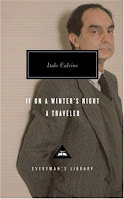
BOOK REVIEW: If on a Winter's Night a Traveler by Italo Calvino

If On a Winter’s Night a Traveler by Italo Calvino is a tremendous, seductive novel about reading. Originally published in 1979, it nevertheless feels fresh (reference to a payphone notwithstanding.) 

I love books about books, writers, and reading, and can often relate to insightful bits in these types of works. But passages in Calvino’s book hit so close to home that I laughed out loud or got tears in my eyes. He not only understands compulsive readers but has the talent to put that compulsion into words.


In this novel, a narrator addresses a Reader as “You.” But this unnamed Reader is a character. Who is about to start reading If On a Winter’s Night a Traveler. Chapters addressing the Reader alternate with chapters of fictional novels. (Yes, all novels are fiction. But these novels don’t exist. They are literally fictional.)

We begin. We, like the Reader, get sucked into chapter one. And then, the read is interrupted. There has been a printer error. The Reader embarks upon an odyssey to find the rest of the book. Along the way, he meets another Reader, also searching for the rest of the book, with whom he would very much like to connect. As the search progresses, he continuously thinks or hopes he has found what he seeks, but it’s always an opening chapter to a different book.

Each step of the way, he is drawn into the next book and wants to continue that one as much as or instead of the first. Amazingly, I was right there with him. Even when a new chapter began, and I knew that it would not be a continuation of the previous novel, and that this one, too, would drop off just when I was hooked, I had to read on! It was frustrating without being infuriating. Each new first chapter was unique and beautifully written. The plot involving the Reader and the woman he pursued was absurd; yet his emotional connection to the reading process and her philosophy of reading kept me as interested in their story as I was in all the stories that I knew would never be finished–yet still had to start.

This novel is thrilling.

Sunday, December 12, 2021

BOOK REVIEW: Olav Audunsson II: Providence by Sigrid Undset

 I received this book for free from Netgalley. That did not influence this review.


I just finished reading Olav Audunsson Book II: Providence by Sigrid Undset, translated by Tiina Nunnally. What an extraordinary achievement this work is. When I was approved for this book, I also bought Book 1: Vows because I knew I should read it first. I’m glad I did. I don’t think this volume, as wonderful as it is, would stand on its own. To fully appreciate what these characters are going through, the backstory is needed. And the story is very well worth reading as a whole.

Providence picks up where Vows left off. The ill-fated young lovers, Olav and Ingunn, have finally been reunited after years and years of separation, guilt, and despair. They suffered extreme hardship due in large part due to cruelties of their families and society, but also due to their own small errors which were compounded by even greater sins. One thing kept leading to another in that book and they really did seem cursed by Fate. But they are now in a position to find that love will conquer all.

It does not.

Providence is a powerful and devastating book. Set in medieval Norway, the landscape is frozen and harsh. Men are dragged off to war by their kings for conflicts in which they have little stake. And God is ever present in their lives as a force that is more oppressive than hopeful. Reaching out for His grace has far-reaching consequences. Neighbors are far less forgiving than God.

Olav Audunsson is now master of a wealthy estate. He brings his wife Ingunn home. He fully intends to put the past behind them and forgive her completely. (She had a child during their years of separation, a son, born after an adulterous encounter that was less her fault than she believes it to be.) She’s unable to forgive herself. When she miscarries again and again, she comes to believe that it’s God’s punishment for her adultery and, more particularly, for abandoning her son. Olav is unable to bear her misery, so he goes and retrieves the boy from the foster parents, claiming him as his own.

This means the familial inheritance will go to an illegitimate heir who is not really Olav’s offspring. If Olav’s relatives ever found out, he’d be in big trouble for allowing the estate to pass outside the family line. It also means if Olav and Ingunn ever do have a son, he’ll take second place to the older boy. For all Olav insists it doesn’t matter to him, it does. He treats the boy as decently as he can, but he just doesn’t like him. And this drives even more of a wedge between him and his wife.

Ingunn is not the only one sunk in despair over a guilty conscience. There is also the matter of Olav’s crime. He murdered the man who seduced Ingunn and hid the evidence. All to protect her honor, of course. He grows increasingly desperate to make his peace with God but if he confesses, he’ll have to do penance, the truth will come out, and everything gained by the original secrecy will be lost. Ingunn and the boy will be harmed. Ingunn insists he can’t do that to her. So he continues to live with the unconfessed sin, growing more and more taciturn and withdrawn.

Ingunn is not a healthy woman to begin with and multiple miscarriages strip her of any strength she might have had. She’s also a terrible housekeeper/female head of an estate. The only time she shows any gumption is in defense of her son. She’s a shadow of her former self. She loses all her beauty. She’s a millstone around Olav’s neck. And yet, they still love each other with the fiercely strong remnants of their original love.

Things go from terrible to unbearable as Olav and Ingunn struggle with their despair. Every once in a while, Olav is overcome by religious conviction, but it’s leached away by Ingunn’s dependency and the knowledge that her ruined life is his fault.

This book is incredibly bleak, as this pared down plot summary shows. And yet it’s beautiful in its harsh way. The characters are so realistic, so human, that it’s impossible not to empathize with their pain.

I don’t know when Book 3 will be released but I’ll certainly read it, hoping things might turn around for Olav, but expecting they won’t.

Tuesday, September 14, 2021

BOOK REVIEW: A Lost Lady by Willa Cather

A Lost Lady by Willa Cather is one of the lesser known novels by the author of O Pioneers!My Antonia and Death Comes for the Archbishop. Published in 1923, this is a lovely classic.


Set in Sweet Water, a western town established alongside the Transcontinental Railroad in pioneer days, the novel focuses on the slow decline of its heroine, Mrs. Marion Forrester. At the beginning, she is the charming young wife of a railroad contractor, Captain Daniel Forrester. Many years older than his wife, he’s an old-fashioned aristocrat, benevolent with a strong sense of duty and honor, and a love of beauty. He’s devoted to his wife and, as he ages, comes to depend upon her completely. 

Mrs. Forrester is widely known for her graciousness, her vivacious charm, and her hospitality. Everyone who knows her loves her, although some of the townswomen do so grudgingly. She does act rather superior to other women and tends toward the catty, though that’s not something her many male admirers notice.

The story is narrated by Niel Herbert, a younger man who has admired Mrs. Forrester since he was a boy and she was a young wife. As one of the better educated, better mannered youths of the town, he is able to appreciate her finer qualities. He’s brought up by his uncle, a judge, who is a particular friend of Captain Forrester, so Niel spends many evenings as a young man in the company of the couple. As the Captain ages and his finances decline, Niel helps keep an eye on them. In the process, he discovers that Mrs. Forrester is not as loyal to her husband as he’d thought, a realization that disillusions him but does not completely ruin his image of her.

When the Captain suffers a series of strokes, his wife takes care of him, but with difficulty. She isn’t meant for a life of boredom and drudgery. Often, Niel finds her smelling of alcohol.

Niel escapes Sweet Water for a time, attending architectural college in Boston, but he returns to find the Forresters sunk low and his own uncle ailing. He delays his return to school until after Captain Forrester dies and Mrs. Forrester sinks to new lows. At this point, he gives up on her. It’s only later that he can recall her with any fondness, and even then, he likes to remember her as she was in her vivacious younger days, before his disillusionment.

There is much in the novel glamorizing the settling of the American West, the superiority of the early settlers and ground breakers, contrasted with the inferiority of those in the next generations. Mrs. Forrester’s decline is emblematic of the loss of luster after the closure of the frontier. Niel’s nostalgia for his youth, his memory of Mrs. Forrester as she was, and Sweet Water as it was, make for a melancholy read.

Wednesday, August 18, 2021

BOOK REVIEW: New Grub Street by George Gissing

Sometimes it’s a little overwhelming walking into a bookstore to browse or wandering the library when I pop in to pick up a book. There is SO MUCH to read. So when I happen upon a reference to a great writer from long ago whose works have dropped off the radar, I have mixed emotions. Can I really squeeze in a book published in 1891 by a writer I’ve never heard of?

The answer, of course, is yes!

George Gissing was a prolific English novelist of the late nineteenth century, who was mentioned a few times in The Age of Decadence. One of his best works is thought to be New Grub Street, which follows the lives of several literary men and women of modest to moderate talent and scant means trying to make their names in the 1880s. 


It’s not a pretty tale. The men with the most talent (Edwin Reardon and possibly Harold Biffen) are destroyed by poverty, as is an intelligent but horribly selfish literary critic, Alfred Yule. The most successful of the bunch is a hack writer, Jasper Milvain, a shallow fellow who pursues money at all cost, seeking the ultimate jackpot of a wealthy wife. The women (Amy Yule Reardon, Marian Yule, and Maud and Dora Milvain) are mainly downtrodden creatures whose happiness and well-being are dependent on whether or not they have men who can provide for them or inheritances that can be used to secure husbands. The theme appears to be that contentment is not possible without money. Although it’s a crass view of the world, the point is well demonstrated. As the novel drew to a close, I kept waiting for a reversal that would be somehow redemptive. Instead, it became apparent that the good people would be crushed and the not-very-good people would succeed by becoming truly awful people. It was agonizingly realistic. The lack of a pat, emotionally satisfying ending is what made the book so powerful.

Despite being written over a hundred years ago, the novel resonates with today’s issues around what constitutes “good” vs. popular literature, the reliability of journalism, and the dumbing-down effect of “mass media.” The explorations of the psyches of the main characters are fascinating. The story pulls the reader in slowly, but the plot builds and interweaves until it is hard to put down. There are startling flashes of wit and numerous clever passages that I wanted to read out loud to whoever was nearby (no doubt annoying my family.) 

I love books about writers. This one reminded me of Lost Illusions by Honoré de Balzac, though that was based in France in the early nineteenth century. They are both superb classics.

The novel is still in print in various “classics editions” and I was able to get an ebook copy from my library. If this is your sort of thing, it isn’t hard to find!

Thursday, August 5, 2021

BOOK REVIEW: Olav Audunsson. I. Vows by Sigrid Undset, translated by Tiina Nunnally

Nobel-prize winning Sigrid Undset is best known for her three-volume novel of medieval Norway, Kristin Lavransdatter, published in 1920-1922. Less well known is her four-volume epic, The Master of Hestviken, otherwise known as Olav Audunsson. It’s also set in medieval Norway, but in the late 13th and early 14th centuries, a generation before Kristin Lavransdatter.

Tiina Nunnally has undertaken a new translation of the masterwork. The first volume, Vows, was published last year.

In this superb historical novel, we meet Olav Audunsson as a boy on the verge of manhood, living with his foster family, a family headed by Steinfinn Toresson. He’s treated with a benign neglect alongside the children of the family. Steinfinn and his wife have other problems and don’t pay much attention to what the children are getting up to.

What makes Olav unique is his bond with the eldest daughter, Ingunn Steinfinnsdatter. When they were children, the two fathers betrothed them in a silly ceremony while drunk. There has been a general acceptance of the betrothal ever since, though no one takes it very seriously except the children themselves. They grow from playmates to best friends. Neither ever questions the belief that they will spend the rest of their lives together.

Olav reaches adolescence. He’s only a year older than Ingunn, but his hormones kick into gear. She adores him, trusts him completely, and is frighteningly innocent. After a critical battle in the adult world, one in which Olav takes part, there is much celebratory drinking and carousing, and Olav and Ingunn slip away and consummate their betrothal. Not a good idea.

Olav is years away from his majority. Ingunn is only about 15. Had the foster parents lived, the marriage might have been rushed ahead, validating the union. But Steinfinn dies of his battle wounds and his wife precedes him, dying rather mysteriously. Ingunn is now a ward of her uncles, who see her as too valuable to give to Olav who, though he may have property to inherit, has no important political connections. Thinking to improve his chances of gaining the bride he thinks of as rightfully his, Olav confesses to the local bishop that he and Ingunn have already slept together. Things go from bad to worse.

The two are parted for years while Olav tries to earn enough clout to claim Ingunn. The unfortunate Ingunn is shelved in a remote estate with an elderly aunt and even more elderly grandmother. It’s a frustrating existence for Olav and a stultifying one for poor Ingunn. 

The novel delves deep into the customs and beliefs of the times. It immerses the reader in the rhythms of their daily lives and the passing of years. It shows how lives are altered by unwise choices and how one mistake compounds another. And yet, through it all, there is a beauty in the love of this pair for one another. It is, according to the author, “the simple story of a man and the people who intervene in his life.” It is that, though Olav was much more active in shaping his own life than Ingunn was allowed to be. Her passivity is painful to a modern reader, but faithful to the historical reality, which makes the novel all that more compelling.

This is gorgeous, epic, old-fashioned historical fiction, in a beautifully fluid translation. I’m looking forward to continuing the saga in book 2.

Friday, October 23, 2020

BOOK REVIEW: Bonjour, Tristesse by Francoise Sagan

One of the books I wanted to read after Au Revoir, Tristesse, was the main book that inspired Viv Groskop: Bonjour, Tristesse by Françoise Sagan. A novella written by the seventeen-year-old Sagan, it launched the career of the author and the cult of personality surrounding her.


The protagonist, Cécile, is a seventeen-year-old girl living with her widowed father after a stint in a convent school. He is a shallow skirt-chaser trying to hold onto his own youth. He does love his daughter, but is happy to have her follow in his carefree, self-indulgent footsteps. They embark on a two-month summer vacation in a rented villa on the Mediterranean, along with her father’s current mistress, a young woman named Elsa. 

Things are progressing happily and lazily. Cécile meets a young law student named Cyril who is summering in a nearby villa, who teaches her to sail. He’s rather an upright young man, but they have a strong physical attraction that grows as time goes on. They eventually become lovers.

Things change abruptly with the arrival of Anne, an old friend of Cécile’s deceased mother, who is organized, morally strict, and conventional. It surprises Cécile to discover the woman is in love with her footloose father. The woman’s calm, measured, grown-up behavior, along with her mature beauty, catch the father’s attention. Before long, he transfers his affection from Elsa to Anne. This is not out of character for him, since he never sticks with one woman for long. But what is out of character is the sudden announcement that he is going to marry Anne.

Cécile is horrified. She doesn’t want the dull, conventional life that she and her father will be doomed to live as “Anne’s husband” and “Anne’s step-daughter.” Even though she does admire Anne and, at times, appreciates the woman’s goodness and forebearance, Cécile doesn’t want her coming between her and her father. She doesn’t want to live a conventional life, and can’t believe her father would be happy either. So, Cécile sets out to sabotage the relationship. She works to bring Elsa back into the picture, knowing her father will inevitably cheat on Anne. 

While it’s tempting to see Cécile as a horrid, spoiled, jealous child – which she is – she also comes across as pitiable. The story is seen from Cécile’s point of view, which is full of contradictory emotions and confusion. Her actions stem from an emotional stuntedness and an adolescent narrowness of focus. The universe revolves around Cécile. She revels in her power and is terrified by it. She regrets the outcome she engineers even as she continues to press for it. Throw in an element of Fate, and the results are even worse than Cécile plotted. She will move on, but she won’t ever be able to forget what happened, or to return to the unencumbered “happiness” of her previous life.

This is a very quick, straight-forward read with surprising depth.