Wednesday, April 13, 2022

BOOK REVIEW: Pandora's Jar: Women in the Greek Myths by Natalie Haynes

 I received this book for free from Netgalley. That did not influence this review.

I loved Natalie Haynes’ novel of the women (and goddesses) of the Trojan War, A Thousand Ships. So when I saw she’d written a nonfiction exploration of a similar topic, Pandora’s Jar: Women in the Greek Myths, I wanted to read it as well.


Haynes is an authority on Greek myths, particularly the women in the tales. This new work looks at Pandora, Jocasta, Helen, Medusa, the Amazons, Clytemnestra, Eurydice, Phaedra, Medea, and Penelope and how they have been viewed through the ages. The earliest appearances of these women (whether human, goddess, monster, or some combination) are often quite different from the versions we have come to know through later--even modern--representations. I was a bit surprised to learn that the early Greek renderings were often less misogynistic than more recent versions. The variations in the stories are fascinating and the reasoning behind the changes are complex. Haynes traces the evolution of the various tales and offers insight into how we’ve come to settle on particular versions, as well as why the stories are destined to continually change.

Haynes has a great deal of empathy for the characters. She writes clearly, with great understanding and with wit. I have always enjoyed retellings of the old myths and I equally enjoyed this analysis. 

I recommend reading Pandora’s Jar and A Thousand Ships in tandem.

Monday, April 11, 2022

BOOK REVIEW: Goodbye, Mr. Chips by James Hilton

I have no idea when I first heard a reference to Goodbye, Mr. Chips. It seems I’ve always been aware of its existence, embedded in the culture, probably from the movie title. Yet I never actually saw the movie or read the book. What is it about? A teacher of some sort? So when I heard it referenced recently, out of the blue, I decided it was time to read the book. To my pleasant surprise, Goodbye, Mr. Chips by James Hilton is a novella that I could read in a sitting.

First published in 1933, the novel peeks in at the elderly Mr. Chipping, known to everyone as Mr. Chips, a retired school teached/headmaster, who devoted his life to a private boys’ school called Brookfield. This is described as no Harrow, but still one of the top second-tier schools in England. Mr. Chips is quite elderly as the book opens. He looks back at his life over the course of a few short chapters.

Mr. Chips’ career spans a busy time in the history of Britain and in the world. He started teaching at Brookfield in 1870 and continued on through the turn of the century, retired just before WWI and came back to help out “for the duration.”


Allusions to the war are made throughout, mainly as poignant mentions of alumni who were lost. One chapter shows Mr. Chips keeping his classroom together and teaching throughout a bombing, courageously helping the boys through the terrifying event. The war is central to the novel, as it was to the man’s life; and yet, the focus is so squarely set on Chips’ involvement with the school that the war is kind of hazily distant, a memory.The novel is mainly about this good man, his love for the school–which to him embodies the ideals of the Englishman, and his love for his country. He is helping to bring up the next generations of Englishmen. Times change, but he remains the same, mostly. Longevity helps him become an institution at the school and he takes pride and comfort in that.

He is an old-school gentleman and the later generations peg him as an old bachelor. However, embedded within the novella is a poignant love story. In middle life, he met, fell in love with, and married a younger woman whose more modern ideas challenged him and whose charm softened him. She died tragically. And he forged on.

The novella packs a lot into its few pages. The storytelling is simple and is mainly presented as narrative with a few short scenes. The secondary characters are sketched in. Even his wife is only fleetingly presented. And yet, there is emotional depth to the story because Mr. Chips is so fully fleshed out.

This is a charming story. And now I’ve finally read it!

Friday, April 1, 2022

BOOK REVIEW: Wellington and the Vitoria Campaign. 1813: Never a Finer Army by Carole Divall


Continuing with my new obsession with the actual history of the Regency Period, I read Wellington and the Vitoria Campaign. 1813: Never a Finer Army by Carole Divall. This is very much a military history, focused on the troop movements, the immediate set-up to the battle, the stages of the fight, and the decisive victory of the British and their allies over King Joseph of Spain (Napoleon’s brother) and the French General Jourdan. It incorporates excerpts from letters, memoirs, and dispatches of the participants. And it includes appendices detailing troop numbers. While rather dry to read, the book is a comprehensive account that succeeds at its task. If you’re interested in episodes in the Napoleonic Wars besides Waterloo, this is a good book to study.


Saturday, March 26, 2022

BOOK REVIEW: Ireland by Frank Delaney

Frank Delaney was an Irish writer and broadcaster who died in 2017. A friend recently recommended a podcast where Delaney walks the listener paragraph by paragraph through James Joyce’s Ulysses. My husband and I started listening to it before discovering that Delaney died before completing the task. We’ll continue on and see how far we get. The same friend also recommended Delaney’s novel Ireland.

Ireland is a storyteller’s history of the country. The framework is clever, using two storytellers, an old man and a young one. They first meet when the younger is a nine-year-old boy.


In the early twentieth century, traveling storytellers still existed in Ireland. They were oral historians who wandered the country, taking shelter where they could, hoping to spend a few nights at a time with anyone who would take them in and feed them in exchange for stories. 

The older man is known only as The Storyteller. He appears one night at the home of Ronan O’Mara, the nine-year-old, who is enthralled by the stories. Ronan’s mother, a cold and embittered woman, is not, and The Storyteller is rather unceremoniously booted from the house after a couple of days. Ronan essentially spends the rest of his life (at least the life covered by the novel) searching for the man.

The novel alternates between scenes from Ronan’s formative years and the stories he manages to collect from The Storyteller (who leaves him letters, or shows up on radio broadcasts, or leaves the memories of his stories with others who pass them on to Ronan.) In addition to the mystery of the identity of The Storyteller, and the fear that the old man will die before Ronan catches up with him, there is also a good deal of mystery involving Ronan’s own family. While poignant and, in the end, believable when all the pieces come together, what I didn’t quite believe was that pretty much everyone in Ireland except Ronan knew his family secrets. Even I guessed them early on. It is believable that Ronan could be kept in the dark. People can be blind to things close to them. What I had trouble with was how widely known his family secrets were. 

Aside from that, the story was lovely. The Storyteller did have a knack for telling a tale. The novel presented a “greatest hits” of Irish history in a historical fiction-like way. It is, however, a long book, and the last 100 to 150 pages started to drag. Ronan’s wandering search for the wandering storyteller lost momentum. The tension — would he find the man on time and why was The Storyteller so purposefully elusive? — stretched thin until I lost interest in the resolution. And some of the later stories/missives from The Storyteller were too self-indulgent. I understand that he loved every rock and flower in his country (as, obviously, does Delaney), but I ended up skimming those bits in the last part of the book as they got repetitive. This is also a man’s book about men. There are women in the stories, but they are bit players and the tone of the novel came across as patronizing, which was a little too quaint. Even so, it’s a novel I’m glad I read.

My friend listened to this as an audiobook read by Mr. Delaney himself. If you enjoy audiobooks, I think that would be a better format. Hearing The Storyteller rather than reading him might be the right way to experience the tale.

Tuesday, March 22, 2022

BOOK REVIEW: The Great Passion by James Runcie

 I received this book for free from Netgalley. That did not influence this review.

The Great Passion by James Runcie is a newly released historical novel that swept me away.

Sometimes a  superb book opens slowly. I have to give it several pages, a chapter, two chapters, before I am caught up. Others have a voice that captures me from the opening words. The Great Passion was one of the latter. The novel drew me in immediately, even though its voice was that of an eighteenth-century man about to indulge in memories of his pre-adolescent self.

The majority of the book is told from the viewpoint of young Stefan Silbermann, a boy whose voice has not yet changed, who sings a beautiful soprano. He is the son of an organ maker from a long line of prestigious organ makers. His mother recently died and his father decides to send him to a music school for boys that is attached to a church, St. Thomas in Leipzig, to further his musical education. This is in preparation for the day when he will take over the family business. Also, sending him away is supposed to help him put aside his grief for his mother.

Stefan spends one year at the school, but experiences so much growth over that year that it seems a small lifetime. The Cantor at the school is Johann Sebastian Bach.

Bach is not named in the novel. He’s referred to as the Cantor. It’s a superb way of placing us back in time to before he was BACH. Not that his talent was not recognized, but his name did not yet have centuries of weight behind it. Keeping him semi-anonymous puts us on a more contemporary footing.


The year of this novel (1727?) is the year that Bach was composing The St. Matthew Passion. And while the storyline culminates in the performance of the Passion, and while the adult Stefan recognizes that this was a pivotal moment in his life and in the history of music, the book is not simply the story of Bach struggling with the composition and ultimately triumphing. The young Stefan experiences the creation of this masterpiece in the context of his own difficult transition from child toward adult. The Passion is both central and peripheral.

With its exquisite prose, the novel is a meditation on death, life, music, religion, and everything in between. Runcie writes with such confidence in his material that there are no false notes. I could hear the language of these deeply religious eighteenth century men and women and feel that I was there, not looking back at them from the distance through a novel. I am non-musical and deeply ignorant about the mechanics of music, and yet I never stumbled over the passages where music was woven into the story. Seamlessly. Detailed without being cumbersome.

There is bullying and kindness, violence and gentleness. Bach is both a temperamental, hard taskmaster and a generous mentor and loving family man. Stefan is a boy on the cusp of manhood and a middle-aged man looking back on a defining year of his life.

This book was not a “page-turner,” but it was hard to put down. I can’t recommend it highly enough.

Thursday, March 17, 2022

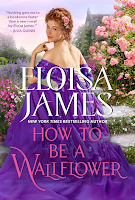
BOOK REVIEW: How to Be a Wallflower by Eloisa James

 I received this book for free from Netgalley. That did not influence this review.

Bestselling Historical Romance novelist Eloisa James has a new novel coming out this month: How to Be a Wallflower.


The heroine is Cleo Lewis. Cleo is an extremely beautiful, hard-nosed businesswoman. Her father (a blacksmith’s son) invented valves for commodes and built a water-closet empire, which Cleo inherited. Her mother was a free spirit – a lady who ran off and eloped, and then never met an actor she didn’t sleep with. Cleo is also the granddaughter of a viscount. Now that her parents are both dead, Cleo wants to have more of a relationship with her grandfather. Naturally, he wants her to marry a worthy gentleman. But she has no interest in marriage at all. First, her husband would automatically gain control of her company and her fortune. And second, after seeing the way her mother constantly hurt men, including her father, Cleo wants no part of love or sex.

The hero is Jake Astor Addison. Jake is very large (all Regency Romance male protagonists are behemoths) and very American. He’s a businessman as well. He’s come abroad to buy things and invest. Eventually, he plans to return to the U.S. and marry the sweet, dull, cow-obsessed woman his mother has picked out for him. Then he meets Cleo.

They are vying for the shop of a theater costumer. It isn’t much of a contest. Jake never met the proprietress and just assumed she and all her staff would move to America for the money he was offering. The woman doesn’t want to move. Cleo offers more money and a chance to stay in London. 

Jake doesn’t like to lose, so he starts making plans to ruin the woman’s business so that she will be grateful for his rescue. Cleo heads him off there as well. They enter into a wager, involving commissioning clothes from the costumer. But before the wager gets far off the ground, Jake falls hard for Cleo and changes his plans. Completely. He doesn’t want the business. He doesn’t want to return to America. He no longer wants to marry the girl at home. He wants Cleo.

Fortunately, Cleo wants him as well. She just needs to be wooed, reassured that he won’t take control of her fortune and her business, and reassured that her need for Jake is nothing like her mother’s need for any man on a stage.

This is an entertaining, fairly quick read. The conflicts are muted. The development of the romance relies very heavily on sexual attraction and much of the plot revolves around their mutual seduction. (The business wager that was set up comes to nothing.) But the characters have interesting internal conflicts. Cleo is clear-sighted and kind. Jake grows from bullying and unlikeable into a devoted, giving man. Fans of Eloisa James will not be disappointed.

Tuesday, March 15, 2022

BOOK REVIEW: The Siren of Sussex by Mimi Matthews

The Siren of Sussex by Mimi Matthews is a refreshingly original historical romance set in Victorian England. 


The heroine, Evelyn Maltravers, is an orphaned country girl brought up (along with her many sisters) by a sympathetic aunt. She is minor gentry, good birth but no title. Her beautiful older sister was supposed to be the family’s salvation, but she ran off with the man she loved, souring the prospects of her sisters. Evelyn is now tasked with going to London for a Season (at age twenty-three) where her disinterested uncle will, with the aid of a dowager friend, help her to launch. Evelyn has been taught to play to her strengths. Considering herself to be plain and tending towards the bluestocking, she knows her strength is her horsemanship. She decides to take the ton by storm by showing off her skill on Rotten Row. To do this, she’ll need to attract attention to herself. She’ll need the services of an up-and-coming dressmaker known for the riding habits he has designed. This habit maker is Ahmad Malik.

The son of a British soldier and an Indian woman, Ahmad has never fit in anywhere. Trained as a tailor of menswear, he is an inspired dressmaker. He hopes to earn enough to open his own shop. For this, he needs the custom of ladies of the ton. He needs someone well-placed to advertise his wares. When Evelyn comes to commission a habit from him, he sees the possibilities. She’s beautiful. And his dresses will make her more so.

They fall in love, of course. But the obstacles facing them are huge. Money is high on the list. Neither is wealthy. Both have family members depending on them for support. Both have nemeses, people who, for various reasons, wish them ill. However, the foremost problem is Ahmad’s parentage. He’s used to being shunned by English and Indian alike. He knows that society will not accept their marriage and he can’t stand the thought of Evelyn being cast out of her world.

While retaining the structure and happily-ever-after ending of historical romance, this novel has a depth and thoughtfulness that is more reflective than usual. The protagonists are strong, progressive, independent thinkers. There are also interesting secondary characters who will likely star in future books in the series. I can’t wait to see their stories.