Thursday, March 10, 2022

BOOK REVIEW: The Paying Guest by George Gissing

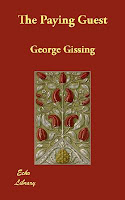
After stumbling across references to George Gissing, a masterful late nineteenth century novelist, and then reading the superb book New Grub Street, I was intrigued to find one of his novellas, The Paying Guest, in our library’s online catalogue. It was initially published in 1895. My library’s copy is a reprint from 1968.

The book can be read in one sitting. It’s written in that wonderful, straightforward nineteenth century style. The principal characters are the Mumfords and Miss Louise Derrick.

The Mumfords are a respectable middle-class London couple who have taken a house in the suburbs for the health of Mrs. Mumford and their two-year-old son. They have a quiet, affectionate marriage. They are not financially constrained, but Mr. Mumford isn’t making much extra. So when he notices an ad in his newspaper, a young woman looking to take a room outside of London, he points it out to his wife. They have plenty of space, and a little extra money would be nice. So they reply to the ad.

After some awkwardness, the paying guest settles in. She is Louise Derrick, a working-class girl with ambition to raise herself but little formal education, a too-forward interest in men, a quick temper, and a wealthy stepfather who is so desperate to get her out of the house that he’s willing to pay anything to lodge her elsewhere. (It seems a Mr. Bowling, who was courting Louise’s stepsister, has shifted his attention to Louise.) There is a vulgarness about the situation and Louise’s family that puts the Mumfords off, but they don’t find Louise so bad. And they do want the money.

Well, Louise is that bad. She can behave well for a few days at a stretch, but she’s restless, untruthful, attention-seeking, and manipulative. She is being courted not just by her stepsister’s ex-fiancĂ©, but also by a rough working class man with a temper to match her own. She doesn’t think he is quite good enough for her. She (and her mother) both hope the Mumfords will introduce her to better.

The classes clash. Louise is the nightmare guest who refuses to leave. The Mumfords, trapped by their own politeness and disgust for “scenes,” are unable to throw her out, even after her stepfather cuts off payment for her lodging.

Anxiety levels are high all around. Mrs. Mumford even begins to question her husband’s interactions with Louise. Her suspicion appalls them both.

It takes a cataclysmic event (which, when the dust settles, wasn’t really that cataclysmic) to dislodge the girl from their lives.

It isn’t a deep book. And there are plenty of contemporary examples of this type of plot that are likely more amusing and more hair-raising. Yet the social class difference gives this novel some poignancy and punch. And it’s fascinating to see that the trope of the obnoxious, disruptive guest who just won’t go was as disturbing and darkly comic in the nineteenth century as it is today.

Tuesday, March 8, 2022

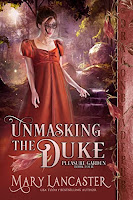
BOOK REVIEW: Unmasking the Duke by Mary Lancaster

 I received this book for free from Netgalley. That did not influence this review.

Unmasking the Duke by Mary Lancaster (Book Four in the Pleasure Garden series) is another delightful, temporary escape from the real world.


Kitty Renwick is the adopted niece of Bill Renwick, one-time criminal ringleader now on his way to building a legitimate commercial enterprise, having begun with the creation of The Maida Gardens. (This is a pleasure park for rich and poor, titled and common, with family-oriented entertainments during the day and masked balls at night, where anonymity allows indiscretion.) Kitty has been raised as a part of Renwick’s family, and believes she is his blood relation, but in truth, no one knows who her real parents were. 

Johnny Winters, the duke of Dearham, is a reforming rake. After the death of his father, Johnny has tried to behave more respectably, even taking upon himself the task of tracking down the daughter of a long-lost cousin who was disowned for marrying against his great-grandmother’s wishes. (She was the duchess at the time and has long since died.) He has enlisted the help of Ludovic Dunne, his solicitor who is also a respected sleuth. It appears that Kitty may be the missing girl.

The mystery unfolds amidst dangerous plots against Bill Renwick, Kitty, and a sideplot involving a mysterious princess/spy, who had once been Johnny’s lover. 

Kitty and Johnny fall for one another, but the deck is obviously stacked heavily against them. Thankfully, since this is Romance, obstacles are there to be overcome.

This is an enjoyable series, light on steam and heavier on character development. The plot is improbable but who cares? There is at least one more book in the series, and I’m looking forward to it!

Monday, March 7, 2022

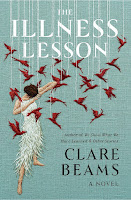
BOOK REVIEW: The Illness Lesson by Clare Beams

The Illness Lesson by Clare Beams is a complicated book, difficult to read and difficult to review. It is certainly beautifully written and psychologically complex. The plot begins slow; it is thought-provoking and melancholy. Symbolic bird imagery lends a touch of magical realism that eases the reader into the unexplainable events that begin to occur, events that suddenly catapult the plot down horrifying, stomach-turning lines that will make you want to rage, or weep, or both. And yet.


And yet there was something unsatisfying in the way it played into stereotypes while calling them out. The bird imagery took off but landed flat. (Fans of magical realism may disagree.) The clearest truth to emerge was the utter lack of accountability of evil-doers. The protagonist saved the innocent…maybe. Or maybe it was too little too late. She saved herself by skirting the issue and removing herself from the situation, which was, admittedly, the only thing she could do. I can’t blame her for her lack of courage. She didn’t really have a workable option; at least she did what she did, and maybe that was the point.

The Illness Lesson, despite being fictional and containing a dose of magic, highlights a very real, oppressive abuse that not only took place in the past, but goes on in the present day, in guises that are only minimally different. The novel illustrates a lesson that hasn’t been learned.

Tuesday, March 1, 2022

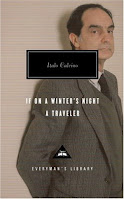
BOOK REVIEW: If on a Winter's Night a Traveler by Italo Calvino

If On a Winter’s Night a Traveler by Italo Calvino is a tremendous, seductive novel about reading. Originally published in 1979, it nevertheless feels fresh (reference to a payphone notwithstanding.) 

I love books about books, writers, and reading, and can often relate to insightful bits in these types of works. But passages in Calvino’s book hit so close to home that I laughed out loud or got tears in my eyes. He not only understands compulsive readers but has the talent to put that compulsion into words.


In this novel, a narrator addresses a Reader as “You.” But this unnamed Reader is a character. Who is about to start reading If On a Winter’s Night a Traveler. Chapters addressing the Reader alternate with chapters of fictional novels. (Yes, all novels are fiction. But these novels don’t exist. They are literally fictional.)

We begin. We, like the Reader, get sucked into chapter one. And then, the read is interrupted. There has been a printer error. The Reader embarks upon an odyssey to find the rest of the book. Along the way, he meets another Reader, also searching for the rest of the book, with whom he would very much like to connect. As the search progresses, he continuously thinks or hopes he has found what he seeks, but it’s always an opening chapter to a different book.

Each step of the way, he is drawn into the next book and wants to continue that one as much as or instead of the first. Amazingly, I was right there with him. Even when a new chapter began, and I knew that it would not be a continuation of the previous novel, and that this one, too, would drop off just when I was hooked, I had to read on! It was frustrating without being infuriating. Each new first chapter was unique and beautifully written. The plot involving the Reader and the woman he pursued was absurd; yet his emotional connection to the reading process and her philosophy of reading kept me as interested in their story as I was in all the stories that I knew would never be finished–yet still had to start.

This novel is thrilling.

Sunday, February 27, 2022

BOOK REVIEW: The Lady Tempts an Heir by Harper St. George

 I received this book for free from Netgalley. That did not influence this review.


Harper St. George’s latest historical romance is The Lady Tempts an Heir. Set in the Gilded Age, this series of novels deal with the new money Americans coming to England to buy titles for themselves (and their social climbing families.) I thoroughly enjoyed the first novel in the series, The Heiress Gets a Duke. I missed the second book but will have to come back to it. In those novels, the exceedingly wealthy Crenshaw sisters are married off to aristocrats after difficult courtships, finding love despite the initially mercenary arrangements.

This third book is interesting because it is the wealthy American son who is being coerced into marriage by his parents, particularly by his tyrannical tycoon father. Maxwell Crenshaw is also a fiercely ambitious businessman, poised to eventually take over the family business. However, he has a heart, and has already come to London twice to support his sisters when they are being forced to marry against their wills. Now he has returned because his father has had a heart attack. By the time he arrives, the father is recovering. But the father is more determined than ever to get Maxwell wed and breeding to ensure the continuation of the family line – to secure the Crenshaw Ironworks legacy. Maxwell would rather take his time and marry for love.

Lady Helena March is a young widow who has thrown herself into charitable works, most notably a home (with daycare) for unwed mothers and their children. She is a good friend of the Crenshaw sisters and had previously met Maxwell and been attracted to him. But now her father is pressuring her to wed again, to find a man to lend her some respectability, especially if she’s going to insist on associating with such undesirable elements. He is not above throwing his influence around to thwart her charity, sure that he is protecting her by doing so.

The older generation of men in these novels is really despicable. But the younger men are more forward thinking and make admirable heroes.

In order to get around the manipulations of both the fathers, Maxwell and Helena embark upon a pretend engagement, planning to cry off once their individual projects have enough momentum that the fathers can’t stop them. Of course, romance readers know how these “pretend engagement” scenarios work out. 

There is a lot of steam between Maxwell and Helena, but a lot of mutual support and admiration as well. This is a fun romance series that’s just a bit outside of the usual Regency Romance setting. This novel can stand alone. And the series can be read out of order, because that’s what I’m going to have to do!

Friday, February 25, 2022

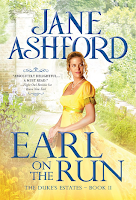
BOOK REVIEW: Earl on the Run by Jane Ashford

 I received this book for free from Netgalley. That did not influence this review.

Jane Ashford writes such sweet Regency Romances. Earl on the Run is book 2 in The Duke’s Estates series. My favorite part of book one, The Duke Who Loved Me, was the quartet of young debutantes who kept a humorous running commentary on the state of the ton and the progress of that heroine’s courtship. Now it’s the turn of one of those debutantes, Harriet Finch, to find her true love.

Harriet is an heiress, suddenly. The grandfather who threw her mother out and harried her father into ruin decided to leave his money to her, provided she serve as his pawn, his entree into society. Grandfather Finch made his money in trade and is desperate to connect himself to the aristocracy. Harriet has no desire to marry for a title. However, her father is dead. And her destitute mother wants a “better” life for her daughter.


Jack Merrill’s story is similar. His father (heir to an earldom) fell in love with a commoner and was banished to America where he entered trade. Jack was perfectly content but was summoned back to England when he inherited his grandfather’s estates. He has no desire to be insulted by the titled, especially not by his haughty, cruel grandmother. So he takes off. Disappears. However, he is curious about the country estate he inherited, so he sneaks off to see it before deciding what to do next.

His country home borders that of the estate bought by Grandfather Finch.

Jack and Harriet meet wandering about the grounds. Neither knows anything about the other, so they are free to invent their personae, which really means they are free to be themselves. Before long, they have fallen in love.

This should be an easy one. The match is something everyone around them wants. They want it themselves. But they haven’t been honest with one another. And they don’t want to marry to please other people. To some extent, their obstacles are invented and could be solved by a good long chat. But they are interrupted at inopportune times. And they don’t entirely trust their own feelings.

The two are kind-hearted and loving. Their goals align. The happily-ever-after is assured once they decide to be honest with one another. They are helped along by none other than James and Cecelia from The Duke Who Loved Me (and it was fun seeing their return.) 

I’m eager to see who the next heroine in the series will be!

Monday, February 21, 2022

BOOK REVIEW: Heiresses: The Lives of the Million Dollar Babies by Laura Thompson

 I received this book for free from Netgalley. That did not influence this review.


Heiresses: The Lives of the Million Dollar Babies
by Laura Thompson is a newly-released book that, just as the title tells us, looks at the lives of heiresses. The women are either British or Americans who, for the most part, married into the English aristocracy. The book starts in the late 1600's with Mary Davies and goes through modern times, with Patty Hearst. The theme is that untold wealth is almost guaranteed to make a woman miserable (although rare heiresses are able to escape the burden of wealth, mainly through philanthropy.) It seems the misery stems from two main problems. First, when being defined by wealth, it is impossible for the women to ever feel loved for themselves. And second, boredom. What is there to do besides spend mindlessly when you have more money than you know what to do with?

They marry tragically, over and over again. They have affairs. They drink and take drugs. If they become mothers, they are terrible ones. 

A surprising number of them are kidnaped and forced into marriages. (I thought this was just an overused trope of Regency Romances. I had no idea it was so common!)

The book looks into the societal, legal, and political disadvantages that these women faced, particularly in earlier centuries. Once married, women had no legal identity. Their money was turned over to their husbands. Their children belonged to the husband. Even their own bodies belonged to their husbands. It’s horrifying. But even in the modern era, there are double standards and issues of consent that make it difficult for women born to gobs and gobs of money. (Also, nobody actually feels sorry for them!)

Heiresses is well written and well researched. The individual stories are interesting. But on the whole, the book didn’t engage me as much as I expected. The litany of miserable heiresses became draining and their stories started to run together, and then I felt guilty for starting to see them all generically. It did demonstrate that a good deal of progress has been made for women, but not yet enough.