Showing posts with label history of medicine. Show all posts

Friday, January 5, 2024

BOOK REVIEW: Wellington’s Doctors. The British Army Medical Services in the Napoleonic Wars by Dr. Martin Howard

I just finished one of my Christmas presents, part of my research into the Regency Era and the Napoleonic Wars: Wellington’s Doctors. The British Army Medical Services in the Napoleonic Wars by Dr. Martin Howard. 

The title gives away the content. It’s a study of how medical and surgical services were provided to soldiers during the wars. It’s a fascinating and well-researched look at the state of medicine and surgery at the time, the politics of supplying these services, the increasing respect accorded these providers over time (starting from a very low bar), and the way these medical officers and their assistants lived while on campaign. The information is a mixture of anecdotes and statistics, and while the statistics are likely approximations, they still provide a good picture of the care available. One of the most damning conclusions is that doctors probably harmed more than they helped.

The book has a narrow focus, but covers the material in this niche of the Napoleonic Wars quite well. For those more interested in the French side of things, the author has written a companion book, Napoleon’s Doctors.

Wednesday, November 18, 2020

BOOK REVIEW: Mary Elizabeth Garrett: Society and Philanthropy in the Gilded Age by Kathleen Waters Sander

Mary Elizabeth Garrett: Society and Philanthropy in the Gilded Age by Kathleen Waters Sander is a conventional-type biography (first published in 2008 and re-released this spring) of an unconventional Baltimore woman in the late nineteenth/early twentieth century.


Mary was the daughter of B&O railroad tycoon, John Work Garrett. A typically ruthless “robber baron,” Garrett amassed a fortune and became one of the leading citizens of the city. During the Civil War, when Baltimore tottered on the edge of the North/South divide, Garrett threw in with Lincoln despite the Southern sympathies of many in his family, largely because he believed it was in his economic interest (and Baltimore’s) to do so.

John Garrett was no philanthropist, but he was a good friend of both George Peabody and Johns Hopkins, exceedingly wealthy Baltimoreans who left huge bequests to found institutions in the city after their deaths. Mary Garrett, who served as her father’s secretary, was witness to this large scale philanthropy and absorbed its lessons.

Despite, or perhaps because of, her father’s increasing dependence upon her business acumen, Mary was not allowed to pursue her own interests or to marry. Although her brothers were given significant roles in the family companies and became millionaires, Mary was given only a “small” allowance and her expenditures had to be approved. This was painfully frustrating for a woman who possessed a better head for finance than either of her brothers.

However, many of the restrictions placed upon her disappeared after her father’s death, when she received roughly a third of the family fortune.

Unfortunately for the family’s long-term relationships, the bequests were all intertwined and caught up in the value of the railroad stock. This led, down the road, to a falling out between the siblings and especially between Mary and her sisters-in-law.

Mary’s share, whether or not she had been cheated out of a significant sum by her brothers’ accounting irregularities, was substantial, making her one of the wealthiest women in the country. As she was unmarried, the money remained hers to control. Mary was determined to use it to help women.

To that end, with the help of four close female friends, she established a prep school for girls in Baltimore. Then she turned her attentions to the newly-established Johns Hopkins Hospital and University. Part of the bequest of her father’s friend Hopkins was supposed to establish a medical school in conjunction with the university. However, the Johns Hopkins endowment was also tied up in B&O stock. When the railroad’s fortunes declined, the money for the university began to run out. The medical school was hopelessly behind schedule and seemed doomed to fail.

Mary Garrett is best remembered for her program of “coercive philanthropy.” She spearheaded fund-raising for the medical school, eventually contributing nearly the entire sum herself, but set conditions on the gift. The main condition was that women must be admitted on the same basis as men. There were medical colleges for women at the time, but they were recognized to have inferior resources to those of medical schools for men. Coeducation for physicians was a practically heretical ideal, but Mary was determined to push for it.

The biography does a wonderful job of demonstrating just what an uphill battle it was to found the Johns Hopkins Medical School on a co-educational principle. 

The book also shows aspects of Mary’s personal life: her circle of friends, her falling out with her family, her health issues. She was an intensely private person, so these parts of her life are less well fleshed out than her more public philanthropies.

Mary Garrett was, in any case, a fascinating woman, and this well-researched biography is highly recommended.

Monday, August 31, 2020

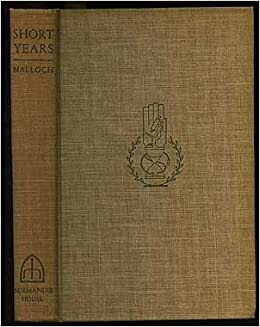
BOOK REVIEW: Short Years: The Life and Letters of John Bruce MacCallum M.D. by Archibald Malloch

 I just finished a beautiful old book, published in 1937, called Short Years: The Life and Letters of John Bruce MacCallum, M.D. by Archibald Malloch.


MacCallum was a turn-of-the-twentieth century, Canadian-born, Johns Hopkins-trained physician/scientist who devoted his short life to experimental medicine. He started out as a morphologist, most known for his work on heart muscle, and ended up an experimental physiologist. He was also a poet, an author of short stories, and a prodigious letter writer.

The book is primarily a chronological collection of edited letters. The author (Malloch) annotates them so that the story flows well but he very effectively keeps himself out of it as much as possible to let MacCallum be the one to breathe life into his own story. The writing is achingly beautiful, full of dreams, aspirations, love of research, love of friends, loneliness, and also humor, imagination, and optimism. I found myself reading passages out loud to my husband because they were just so striking. 

What gives this book particular depth and poignancy is that the young physician/scientist contracted tuberculosis while a medical student. Although in earlier letters the dreaded diagnosis is only hinted at, he worked in a place where the symptoms were very readily recognized, tuberculosis was rampant in American society, and his older brother was also a physician. John MacCallum undoubtedly knew his diagnosis and prognosis from the very first. 

He devoted himself to work, accomplishing an extraordinary amount in his short years, despite his physical limitations. He made friends wherever he went, and his death was hard felt by a large community of medical and non-medical people from Canada to Baltimore to Berkeley. 

He also had two romantic friendships with women with whom he corresponded for many years. It’s unclear how the relationships might have progressed had he been healthy, but it does seem that his illness put up a wall against marriage, even if he had been inclined to pursue it. The book has a very early-twentieth-century way of preserving the anonymity of these women, referring to one as “Miriam,” which was not her real name, and the other as “the poetess.” It’s frustrating not to be able to identify who they were and it seems time erased the trails. And yet, their identities don’t really matter.

One of the fascinating things about the book is how MacCallum will write to a friend, to his parents, to his mentor, and to his brother letters covering the same event, written within a couple of days, and put different spins on it for each audience. He might use the same turn of phrase a couple of times, but then elaborate on or play down his thoughts on what he’d done or what took place. It gives a more rounded picture of the man and really humanizes him.

I love epistolary novels, and this book reads like one. It makes me wish people still wrote like this. Instantaneous communication is wonderful, but what a loss for the literary world and for future historians to think that people’s voices won’t be preserved in this way for posterity.

Saturday, August 1, 2020

BOOK REVIEW: The Invention of Medicine. From Homer to Hippocrates by Robin Lane Fox.

I received this book for free from Netgalley. That did not influence this review.

I just finished The Invention of Medicine. From Homer to Hippocrates by Robin Lane Fox. I’ve been dipping into some history of medicine lately, so this book caught my eye on Netgalley, even though it goes WAY back in time–back to the “invention” of medicine.

The author is a historian, known for his work on Ancient Greece. I should have recognized from this that the book would be pretty dense and academic; in other words, way over my head. But even so, I found much to appreciate in the information being presented. The author is clearly knowledgeable in his field and his enthusiasm for the subject and for his theories pulled me in. He was able, at times, to make it relatable to 2020, surprising me with how up-to-date the book is, given how in-depth the study was. When it wandered too deep into the weeds, I had to take a step back and let it wash over me, but I imagine that for scholars of ancient Greek history, the things I found less interesting are exactly the things that would excite debate.

In short, the author looks at the development of “medicine” as a craft. Surely there were healers before there were doctors, but he makes a distinction between the two. Starting with the famed doctors named in the Iliad, who were concerned mostly with treating war wounds and who attributed much non-traumatic (and some traumatic) sickness and healing to divine intervention, the book moves on to the body of work comprising “Hippocratic” medicine, which progressed beyond looking to gods/goddesses for explanation to looking at man/woman as part of Nature with innate illnesses. There was something more scientific in their methods, even if they got just about everything wrong.

The bulk of the book, and Fox’s central argument, goes to build a case for ascribing a portion of the Hippocratic corpus, namely books 1 and 3 of the Epidemics, to that actual person: Hippocrates. Not being a Greek scholar, it all sounded plausible to me, but what really impressed me was how much is known from the fifth century B.C. The author is trying to nail down the identity of real people living millennia ago and placing them within narrow 50-60 year time periods. I was struck more by the methodology than by the argument.

My overall impression is that this book can be read through a number of different lenses and so may appeal to a broader audience than historians of Ancient Greece or medical historians.

Friday, January 31, 2020

BOOK REVIEW: Bellevue: Three Centuries of Medicine and Mayhem at America's Most Storied Hospital by David Oshinsky

It might seem a 370+ page book is overkill for a history of a single New York City Hospital, but Bellevue: Three Centuries of Medicine and Mayhem at America’s Most Storied Hospital by David Oshinsky, was a nice surprise. I got the book from my library to see what it had to say about a specific moment in its history, but started reading from the beginning just because, and ended up reading the whole thing.

The book covers the history of the hospital from when it was little more than a pesthouse for yellow fever victims in the Colonial period to a modern-day facility equipped to deal with Ebola.

More than a history of New York’s most resilient public hospital and teaching facility for new physicians and nurses, Bellevue is a history of medicine in America in microcosm. Well-researched, readable, and chock full of interesting anecdotes, this book held my interest from start to finish.

Friday, December 30, 2016

BOOK REVIEW: Women Medical Doctors in the United States before the Civil War by Edward C. Atwater

I received this book for free from Netgalley. This did not influence my review.

Women Medical Doctors in the United States before the Civil War: A Biographical Dictionary by Edward C. Atwater is a true labor of love. The author compiled a list of 280 women who received MD degrees during the 13-year period from 1849 (the year the first woman received an MD) until the start of the Civil War. Medical school itself was nothing like what we know today. Regularly-trained physicians competed for patients with other doctors trained as homeopaths or as water cure experts. Given the primitive range of treatments available to regular doctors, outcomes were often better for patients treated with homeopathy or water cures. Female physicians generally tended to women and children, and often lectured to the public on health and hygiene. But there were women serving their communities in the same capacity as male physicians in this early time period.

The book lists the women alphabetically and provides as much biographical information as the author could cull from census records, newspaper or periodicals, books (some of the women wrote books or pamphlets), and occasional letters. Some of the women left behind enough of a record to piece together a glimpse of their lives, while others remain a blank, with only the barest demographic information available. In many cases, it isn’t even possible to know for sure if they practiced medicine after earning their degrees. Other women not only practiced but taught in medical schools.

Despite the encyclopedic nature of the book, it is surprisingly readable and oddly fascinating. It’s a difficult book to get through all in one sitting, but it’s a great book to read in bits and pieces.

Anyone with an interest in the history of medicine might like a copy of this book for their shelves.

Sunday, November 20, 2016

BOOK REVIEW: The Gene. An Intimate History by Siddhartha Mukherjee

Siddhartha Mukherjee, author of the amazing popular science book, The Emperor of All Maladies: A Biography of Cancer, has a new book out: The Gene: An Intimate History.

As in his first work, Mukherjee mixes the human element (the strivings, successes and disappointments of real people, this time mostly scientists) with a heavy dose of scientific explanation, in order to introduce the reader to a vast topic. The history of man’s understanding of the gene is complex and fascinating. This lengthy book takes us back to Darwin and to Mendel and his peas, and follows the unfolding drama of genetic discovery right up to the present, to the Human Genome Project and the beginnings of gene therapy, with all the ethical and moral dilemmas this knowledge presents.

Mukherjee has a gift for synthesizing large amounts of information and presenting it in a readable, clear way. The most engaging parts of the story follow the important people in the history of genetic discovery. The book gets more bogged down when discussing the science. Although the author’s ability to illustrate complicated ideas in a comprehensible fashion is impressive, the line between going too far into the weeds to explain crucial experiments and skimming over the details to present a summary of the significance of results is a very difficult line to walk. At times, the balance is a bit off. I found myself wanting a more in-depth description of some of the experimental processes. At the same time, I felt that the author’s emphasis on some of the more crucial concepts grew repetitive.

Given the scope of this remarkable book, readers shouldn’t be put off by a little unevenness. To grasp the enormous strides made in understanding life itself that have been driven by an increasing understanding of genes, this book is a must-read. It may not be as compulsively readable as The Emperor of All Maladies, but The Gene demonstrates once again that Siddartha Mukherjee is a brilliant communicator.

Friday, March 11, 2016

BOOK REVIEW: An Anatomy of Addiction. Sigmund Freud, William Halsted, and the Miracle Drug Cocaine by Howard Markel

Sometimes history books are informative and well worth reading, but somewhat of a slog to get through. Other times, nonfiction history can be as enjoyable to read as a historical novel. An Anatomy of Addiction. Sigmund Freud, William Halsted, and the Miracle Drug Cocaine by Howard Markel belongs to the latter category. I read this in two sittings and didn’t want to put it down, despite being in the grip of a horrendous cold that made sleep a temptation and necessity.

This dual biography shows the course of the professional careers of Sigmund Freud and William Halsted, both of whom became addicted to cocaine while experimenting with the new drug. Each used himself as a research subject. Freud (everyone knows Freud, the father of psychoanalysis) hoped to make a name for himself by exploring the medicinal uses of cocaine, particularly as an antidote to the addictive properties of morphine, a huge problem in his day as in our own. Although rather insistent on his success, it’s clear he missed the boat.

William Halsted is one of the pioneers of modern surgery. He was the first chief of surgery at the newly opened hospital/medical school/research institution Johns Hopkins. Aware of initial research that showed cocaine to be a very effective local anaesthetic, Halsted realized how useful local injection could be during surgery. To perfect the injection technique, he practiced on himself.

Both men spent a lot of time in denial about cocaine addiction. Both also experimented with morphine as a way to ease symptoms of withdrawal from cocaine. And both had rather tormented or, at least, difficult interpersonal relationships, with marriages that were very likely harmed by cocaine abuse. And yet, both men were considered brilliant in their fields and made significant contributions to medical science.

The book is written in an engaging style. It is extensively footnoted. The author is an M.D./PhD and a professor of the History of Medicine so his explanations of the mechanisms of action of cocaine and of morphine are thorough yet easily understandable. His knowledge of addiction science also informs his conclusions about how Freud and Halsted managed, somewhat, to hide their addictions from friends and co-workers who didn’t really want to see what was going on, and some of whom were users themselves. He also refuses to buy into any myth that the success of these men was because of their drug use, theorizing instead how much more productive these men could have been if not caught in the throes of addiction.

Sunday, January 17, 2016

BOOK REVIEW: Health and Wellness in 19th-Century America by John C. Waller

Every once in a while, I dip my toe into the ocean of the history of medicine. Health and Wellness in 19th-century America by John C. Waller is part of the Health and Wellness in Daily Life series published by Greenwood. Although I think I would find their Health and Wellness in Antiquity through the Middle Ages more interesting, I went with 19th-century America because it’s a time of great change, encompassing the birth of modern medicine.

This book takes a broad view of the subject, looking at the roles of environment, education and training, faith and religion’s overlap with medicine in healing, the health of women, children and infants, infectious diseases, occupational hazards, war, the rise of commercial pharmaceuticals, the changing place of hospitals, and a host of other topics. The differences in medical care for rich and poor, and between white, black, and Native American populations are also pointed out each step of the way. There is a fair amount of repetition from chapter to chapter, but this is helpful if you are particularly interested in one or a few of the topics but not in the whole book.

As is typical in such sweeping introductory books, it conveys a lot of information but broadly, without a whole lot of depth. I found a few things I would like to know more about, so this is a great jumping off point. After I delve into a couple of the topics, I may go locate a copy of the Antiquity through Middle Ages volume.

Sunday, December 30, 2012

BOOK REVIEW: Destiny of the Republic by Candice Millard

I don’t read a whole lot of nonfiction unless it’s for research purposes. When I do, I don’t usually choose books focused on American presidents. However, I spotted a review of Destiny of the Republic by Candice Millard over at Reading for Sanity and I was intrigued.

The book, subtitled: "A tale of Madness, Medicine, and the Murder of a President," is the story of the assassination of President James Garfield. Elected in 1880, Garfield was only four months into his presidency when an assassin tried to take his life. The gunshot wounds were not immediately fatal. In fact, they very well might not have proved fatal at all but for the medical attention Garfield received–repeated non-sterile probing of the wound–that caused him to eventually die of infection, his body riddled with abscesses.

A few years ago, I read a short history of medicine in America book that included a short account of Garfield’s murder. Knowing as little as I did about Garfield, I found it interesting that his physicians had contributed so substantially to his death. I was curious to learn more.

Millard’s account goes beyond the details of the assassination to paint a fuller picture of Garfield the man and to place him in the context of his times. Brilliant, affable, and reasonable, Garfield had been nominated at the 1880 Republican convention against his own will and had no desire to become president. However, he was very well regarded and the consensus seems to be he would have been an exceptional president.

The assassin’s life story and motivation for murder was also explored. A loner who bounced from failure to failure—spending time in a religious commune, as a lawyer, as a traveling evangelist, even a short stint in prison—Charles Guiteau had grandiose visions of his own importance. His own family members were certain he was insane. Upon Garfield’s election, Guiteau became convinced that he would be given a high position in the government. He traveled to Washington and began haunting the White House, writing numerous letters to Garfield and to other prominent men explaining his expectations. Eventually his delusions took over completely, and he decided Garfield had to be "removed." He bought a gun, looked for the opportunity, and shot him.

The record continues with the disastrous medical care Garfield received. It also includes a discussion of Alexander Graham Bell and the attempts Bell made to hurriedly invent a device to locate the bullet lodged somewhere in Garfield’s body. For more than two months, the doctors (particularly the arrogant and painfully wrongheaded Dr. Willard Bliss) hovered about, making things worse, while Garfield died a slow, painful death without ever losing his dignity or gentlemanly demeanor.

In this straight-forward, well-organized narrative, Millard blends politics, history of medicine, and a touching love story to show that Garfield’s story was a fascinating one even if his presidency was tragically short-lived.

Wednesday, November 21, 2012

BOOK REVIEW: Open Wound. The Tragic Obsession of Dr. William Beaumont by Jason Karlawish

I recall that way back in medical school little tidbits of history of medicine were sometimes dropped into our lectures to make things interesting. When we were learning about digestion, an anecdote was related to us about an army surgeon who studied the stomach thanks to a fortuitous abdominal wound in one of his patients. The wound never fully healed, leaving a gastric fistula–an opening from the skin directly into the stomach. The surgeon could put food in on a string and pull it out after a time, allowing him to visualize the digestive process.

It’s a story that is at once repellent and fascinating. Moreover, there’s something ethically uncomfortable about the surgeon experimenting on his patient. But it’s one of the many medical curiosities that get thrown at you in medical school as you are busily trying to memorize too many facts. That little piece of information gets filed away and forgotten.

And yet, precisely because of that ethical discomfort, this piece of medical history deserves more attention. Dr. Jason Karlawish, a professor of medicine and bioethics, has written a fictionalized account of the interwoven lives of the army surgeon, Dr. William Beaumont, and the patient, Alexis St. Martin. In Open Wound, The Tragic Obsession of Dr. William Beaumont, Karlawish delves into the psychology of the surgeon, exploring his reasons for pursuing the experiments and his fascination with his patient. It also lays bare the clear ethical transgressions, a problem evident to everyone except the tragically obsessed doctor.

Alexis St. Martin was a young indentured servant employed by the American Fur Company in 1822 when he was accidentally shot in the abdomen at the company’s store. At first, the company employees send for the local doctor, U.S. Army Assistant Surgeon William Beaumont. But as it quickly becomes clear that his injuries must be lethal, the head of the company suggests/insists that Alexis be made comfortable in the storeroom and there be allowed to die. No one wants to be responsible for paying for his treatment if he is going to die shortly anyway. Beaumont can’t do it. He is unable to abandon a patient without attempting to provide better care. Therefore, he carts him off to the army hospital, against orders. Beaumont is firmly on the right side of this moral dilemma.

The course is difficult and prolonged, but eventually Alexis recovers...almost. The fistula remains–a window into his stomach. Beaumont realizes that this is a perfect opportunity for studying the physiology of gastric digestion. And here is where things go awry.

William Beaumont is an ambitious man. Throughout the course of the book, the roots of his own insecurities are explained. He needs to rise above his humble beginnings. He wants to support his wife (and eventually his children) in finer style than is possible as an assistant army surgeon. He wants to be recognized for his accomplishments. Alexis’s stomach is the means to Beaumont’s end. Alexis’s suffering, physical and psychological, are immaterial. After all, Beaumont saved his life and was prepared to support him as a charity case. Alexis owes him.

The novel traces the remainder of Beaumont’s career, with and without Alexis, and relates the culmination of the experiments as well as the aftermath. We are nearly always following Beaumont’s point of view, only rarely Alexis’s. And while Beaumont tries very hard to make his own case, it’s all too easy to look back from a modern vantage point and see his error. He manipulates and belittles Alexis, rationalizing the need to do so because of the importance of the scientific contribution. It may be easy to judge Beaumont and dismiss this as an error of early 19th century medicine, except that we have to remember how often in the past, and sometimes the not-so-distant past, patients were exploited in the name of scientific and medical advancement.

For anyone interested in the history of medicine or anyone who loved The Immortal Life of Henrietta Lacks and didn’t get quite enough immersion into medical ethics, you might want to give Open Wound a try. It’s a thought-provoking read.

Wednesday, April 18, 2012

BOOK REVIEW: The Emperor of All Maladies. A Biography of Cancer by Siddhartha Mukherjee

I have to find a cheerier book to read next.

Over spring break I decided to tackle The Emperor of All Maladies. A Biography of Cancer by Siddhartha Mukherjee. It’s a brilliant book. If you’re looking for a better understanding of the big picture of cancer, this is where to go.

I heard about this book awhile ago – it was, after all, the 2011 Pulitzer Prize winner for general nonfiction – but was not in a hurry to read it because, well, it is a fairly hefty-looking tome about cancer.

As a pathologist, I have a fair acquaintance with cancer – I know what it looks like. Pathologists look at resected organs and at specimens under the microscope, and one of the main questions we’re supposed to answer is: "Is it cancer?" So we have to know how to recognize it when we see it. I’m a pediatric pathologist, so we’re generally looking for a specific subset of tumors that occur in children. Over the years I’ve grown more accustomed to seeing the comparatively rare pediatric cancer variants rather than the much more common breast, colon, lung and prostate cancers that plague adults. However, as I’ve gotten older, those adult cancers have begun to swirl around me in a different way – they’ve begun to invade the circle of my friends.

So I decided I wanted to read this biography of the disease. I knew the book would be a history of cancer, but I was expecting something dry and more textbook-like. I wasn’t prepared for the scope of the book or for the clarity of the prose. Mukherjee is a physician/scientist but he is also a writer. He makes complex problems accessible without oversimplifying. He is able to take the reader backward and forward on a remarkable journey alongside the pioneers of cancer treatment, political advocacy, and research. He walks with patients, both survivors and those who succumb. Cancer treatment has not been a straightforward march from ignorance and poor outcomes to increasing knowledge and therapeutic success. There have been a lot of false starts and bumps in the road. Cancer is not one monolithic disease seeking one magic bullet, and the battle against it makes for a fascinating, heartbreaking tale.

In this extraordinarily readable book, Mukerherjee lays out the pathways that were explored, increasing incrementally the knowledge about specific malignancies. He explains how therapies added to understanding about cause and vice-versa. In the final chapters, we get to the unraveling of the genetic mechanisms of some cancers and the promise that molecular research holds for the eventual understanding of more and more types of cancer. Understanding the mechanism has led to some targeted therapies and will hopefully lead to more. The book is cautiously optimistic and I came away from it feeling like I had a better understanding of where cancer biology and treatment have been and where they are heading. Unfortunately, it’s also clear that there’s no escaping the suffering cancer has caused and will continue to cause.

If you’re curious about cancer, I highly recommend The Emperor of All Maladies - and the Pulitzer committee agrees.

Still, the next book I read has got to be fluffier.

Friday, October 22, 2010

FRIDAY-ANYTHING GOES: The Immortal Life of Henrietta Lacks by Rebecca Skloot

It’s just not as much fun reading nonfiction as it is reading novels. And since I read to get-away-from-it-all, it’s not often that I pick up a book about medical topics to read for fun. And yet, this past spring/summer, it seemed everywhere I looked I saw The Immortal Life of Henrietta Lacks by Rebecca Skloot. The story sounded so compelling and the reviews were so uniformly glowing, that it was impossible for me to ignore the book.

Rebecca Skloot is a science journalist who, for a long time, had been obsessed with the story behind He-La cells, the immortal line of human cervical cancer cells that revolutionalized biological and medical research. Who was "He....La...."?

The Immortal Life of Henrietta Lacks tells the story not only of the woman, but of the researchers who took her cells seeing them only as biological material. It tells the story of an industry that has grown up around such "biological material" and the ethical dilemma created by this type of research. Of course we all want to see advances in medical research. We want vaccines to prevent infection. We want better diagnoses and treatments for cancer. But at what human cost?

This book elegantly explores the toll medical research has taken on some of its human subjects. Recounting some of the horror stories in the days prior to bioethics regulations, it highlights how harm can occur through sins of omission that are just as devastating as damage inflicted intentionally or by negligence. Henrietta never gave permission for her cells to be used. It was more than twenty-years before her family learned that her cells were still alive and growing, and that other people were making fortunes from these living offshoots of the cancer that killed her.

Skloot examines the issues from all sides and the book gives a balanced journalistic view of the researchers and the industry’s parts of the story. However, she treats the family with particular compassion and sensitivity. It is through her eyes that we are able to really understand how different family members viewed what had happened to Henrietta, and, by extension, to them. And it is heartbreaking.

From start to finish, this is a gripping story. And an important one. For anyone contemplating a career in the sciences, it’s a must read.