Monday, January 31, 2011

ESCAPE TO THE PAST WITH: The Stolen Crown by Susan Higginbotham

The Stolen Crown by Susan Higginbotham escorts the reader through the whirlwind events of the reign of King Edward IV (of the House of York) who captured the throne of England from King Henry VI (House of Lancaster). We enter the story when Edward is almost secure on the throne, secure enough at least to marry the dowerless, influence-less Elizabeth Woodville, which causes a fair amount of difficulty. Those familiar with the history know what comes next. For those who don’t...

The king quickly awards the numerous Woodvilles with wealthy, titled spouses (to the irritation of the remaining nobility.) Kate Woodville is Elizabeth’s youngest sister and one of the protagonists of this engaging novel. Kate is wed to the young Duke of Buckingham, Harry Stafford. Harry, the other protagonist of the book, as we learn at the outset of the novel, will later be condemned to die as a traitor. The novel then shows us how this all came to pass.

The book is told in the dual first person voice. We listen to Kate and Harry both tell their stories. It’s a good device, because the history is complicated. Coming from the minds and voices of children it is narrated simply and straightforwardly. There is not a lot of extraneous political analysis, we are only given the same amount of understanding necessary for the self-interested very young duke and duchess, but it moves the tale along.

And move along it does!

Harry is close friends with Richard, the Duke of Gloucester. Higginbotham does a wonderful job of portraying Richard as slyly manipulative while Harry is guileless, easily manipulated, and self-important. With a few words here and there, Richard sows the seeds for years, solidifying Harry’s dependence and loyalty to him. Kate, who begins as a curious and lively child, grows into a loving and, for the most part, dutiful wife. Although she doesn’t shine with any great intelligence, she is a much better judge of character than her husband and possesses the intuition for doing and saying the right thing at the right time—a skill Harry sorely lacks.

This is a historical time frame that is filled with all the elements for a riveting read: passion, betrayal, murder, unbridled ambition leading to unspeakable crimes. Higginbotham shows us all that by using the viewpoints of two historically marginal characters who witnessed it all.

The book is written with the confident touch of an author who knows her history. A list of characters at the beginning will help you keep all the names straight. At the end, an author’s note points out which bits of information are factual, which are fancy, and what may be factual but is disputed.

Susan Higginbotham has a few more books to her name, and now, I will have to add them to my TBR list.

Saturday, January 29, 2011

Visit me at YA Bliss

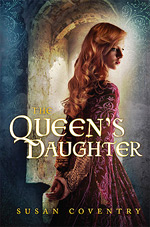
I'm guest posting (yacking away) over at YA Bliss about medieval historical fiction as part of the YA historical fiction challenge events. If you head over to the link, I think there is still time to enter the January giveaway, which includes a chance to win a copy of The Queen's Daughter or Crossing the Tracks by Barbara Stuber.

Friday, January 28, 2011

100 Followers Giveaway

I've reached 100 followers! Thank you all for visiting my blog. To celebrate -- and to clear out my bookshelves just a bit post Christmas -- I'm hosting a YA giveaway. I've selected two wonderful books:


and
 Five Flavors of Dumb by Antony John.

To enter the giveaway, fill out the form.

You don't have to be a follower (although it's nice if you are.) And this time around I'm keeping it simple, with no extra points for tweeting, blogging, etc. (I'm still figuring out the whole google docs spreadsheet thing.)

The contest will run until Feb 28th. Good luck!

Blog Hop 1/28-1/30 -- is it next year already?

Hop on over to Crazy for Books for this weeks book blogger hop. This week's question, posed by Aliyah from Des Absurdites is:


"What book are you most looking forward to seeing published in 2011?  Why are you anticipating that book?"

Unfortunately, I have no answer for this one. I already have so many books stacked up waiting for me that I'm not mentally prepared for 2011 books. I'm sure as I start to see the new releases around and read blurbs and reviews, I'll give in to the temptation to acquire more books. I'm resigned to my ever enlarging TBR pile. But at this point, I'm most looking forward to making time to read the books I already have. I've been anticipating reading some of these for quite some time. So I don't tend to pay a whole lot of attention to books that haven't been released yet.  (Unless Margaret Frazer has a new Joliffe book coming out!)

Oh, good Lord. What is wrong with me? Delete, delete! The book I am most eagerly anticipating this year will be released in the fall. The working title is Fanny and Cecelia. The author is Brad Asher and it will be published by the University Press of KY. It's the true story (nonfiction) of an escaped Louisville slave and her high society mistress, and their correspondence after the civil war-- until the now free woman moved back to Louisville. It's a fascinating story.  And my husband wrote it! 

I'll be posting a more in depth review once I see it in its final form. (Yeesh. I can't believe that slipped my mind. Fall is far away, but it's still in 2011!)
Book Blogger Hop

Wednesday, January 26, 2011

YA BOOK REVIEW: A Northern Light by Jennifer Donnelly

I recently read Revolution by Jennifer Donnelly and was surprised by how much I enjoyed it, considering it’s more of a time-slip than a historical. Donnelly is an amazing writer. So I was very pleased to learn I didn’t have to wait for her next book. She had already written another YA historical, which meant I could count it toward the YA historical fiction challenge.

A Northern Light by Jennifer Donnelly is based on the true story of the murder of Grace Brown, a young woman who was drowned on a lake by a resort hotel in upstate New York in the summer of 1906.

The novel is told from the viewpoint of Mattie Gokey, a seventeen-year-old farm girl. Her mother is dead. Her father is left alone to bring up four girls, and Mattie is the eldest. The responsibilities weigh her down and make her feel trapped. What lifts her up is a love of words as well as a talent for writing that has earned her a full tuition scholarship to Barnard. She dreams of a way of life different than the hardscrabble one she knows, but the scholarship isn’t enough to pay for her escape from the farm. She needs train fare, room and board—which are all out of reach. And when her handsome neighbor inexplicably comes courting, she grasps at the possibility of love, imagining she might be able to exchange one dream for another. Until the town is faced with the drowning death of the young tourist, Grace Brown. As Mattie discovers the truth about Grace, she also learns deeper truths about herself.

Once again, I was swept away by the strong characterizations and the beauty of Jennifer Donnelly’s writing. I highly recommend this moving story!

Monday, January 24, 2011

ESCAPE TO THE PAST WITH: Waverley by Sir Walter Scott

For my first official historical novel review of the new year (official because the book was begun and completed in 2011) to be used for the Historical Fiction Challenge, I’ve chosen Waverley by Sir Walter Scott.

Waverley is not only Scott’s first novel (before that he was a well-regarded poet and translator) but it is also regarded as the first historical novel. This is an interesting piece of information in itself, and gets to the heart of the question "What is a historical novel?" But I’m not going to wade into that minefield here. Scott’s intent, aside from making money, was to use fiction to preserve a way of life that was disappearing, to keep alive the memory of historical events and people who were a generation away from being forgotten. The book and its successors were wildly successful. However, he is not much of a favorite today. Out of the more than 20 novels he wrote, most people can come up with Ivanhoe, but would be hard pressed to name another. (Myself included. I read The Heart of Midlothian several years ago, in order to review it for The Historical Novels Review. But other than that, I knew nothing of Scott’s work. I hadn’t even read Ivanhoe.)

Published in 1814, Waverley relates the story of young Edward Waverley’s involvement in the Jacobite Rebellion of 1745. This was an attempt to put Bonnie Prince Charlie (a Stuart) on the throne of England. Waverley was an English gentleman, whose family had some repressed Jacobite sympathies. However, his family purchased him a commission and off he went to Scotland as an English soldier. While there, he takes an extended leave to visit a family friend. In a roundabout way, he is introduced to Fergus MacIvor, a chieftain with connections to Prince Charles. And he also meets Fergus’s beautiful sister Flora. Waverley gets swept up in the rebellion, almost without volition, and certainly without conviction. The rebellion plays out around him and he sees it through to its end.

The book is worth reading for a variety of reasons, but be forewarned it is tough going. The pace is slow, particularly at the beginning. Some of the dialect is almost indecipherable. And the protagonist is the least heroic hero I’ve ever come across in an adventure. This is intentional. Waverley’s character is clearly spelled out from the beginning. He’s not a bad person or a cowardly one. He is just shallow and self-centered. But that’s apparently OK, since everything works out to reward him in the end.

So far, my review doesn’t sound very tempting. Where is the "worth-reading" part? Aside from the very satisfying feeling you get from turning that last page of a lengthy classic, a historically significant piece of literature, and thinking "hurray, I did it" – was the book itself interesting? Well, yes it was. Scott does a beautiful job creating the characters. I may not have been overly fond of Waverley as a person, but I could certainly recognize him. There was something real and timeless about "a Waverley." He acted consistently true to form as he vacillated from one set of beliefs to another and from one love interest to another. The bombastic old general, the stuffy polite English commanders, the valiant, politically motivated and quick-to-take-offense, and yet steadfast Fergus, they were all remarkably real even if they were "types." This was an odd book because even though I didn’t particularly "care about" the characters, I was interested in what would happen to them. I was interested in how the plot would play out and what roles the major players would have as it all unfolded.

Moreover, the language of the book is gorgeous. Yes, it’s a bit overstuffed. Yes, it lapses into different languages and dialects and eventually I gave up flipping to the notes at the back because I figured I didn’t have to get every little reference to enjoy the book. It has delicious vocabulary. The people speak to each other with intelligence and wit. And although there are slow points to the book, there are also points of adventure and tension. Finally, the book is full of high and low humor.

Sir Walter Scott is not going to become one of my favorite authors. I don’t feel compelled to run out and read the whole series of Waverley novels. However, one of these days, I am determined to tackle Ivanhoe.

Saturday, January 22, 2011

Tracking my challenges. Any Advice?

Here's a question for my fellow bloggers who have participated in reading challenges in the past: how do you put those little bars underneath the pictures that track the percentage of your progress?

I've browsed through the various gadgets available in blogger but nothing looked close. I tried googling for help, but I can't seem to come up with the right combination of words for what those things are even called.

This is giving me a bad case of technology envy.

Is this something that requires lots of time and venturing into using code? Or is it just finding the write gadget to insert?

Any suggestions will be greatly appreciated!